HAITI POLITIC — SPECIAL LEGAL INVESTIGATION
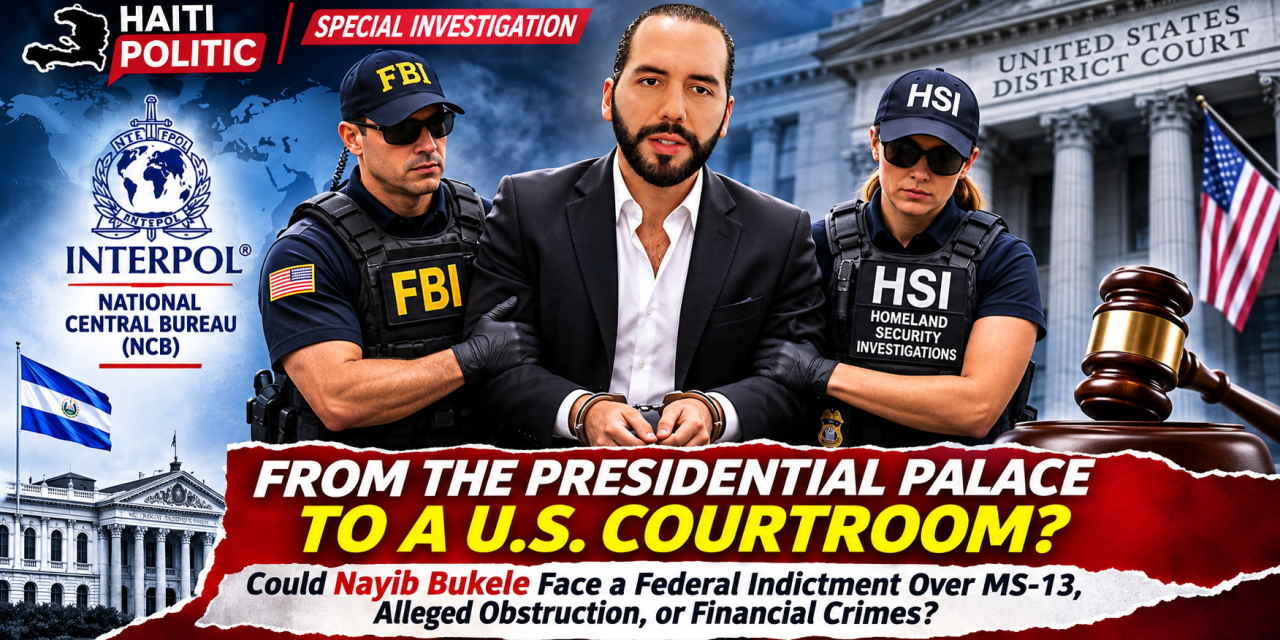
Washington has investigated alleged dealings between Salvadoran officials and MS-13. Congress has considered sanctions against Bukele’s administration. But could those controversies ever lead to criminal charges against El Salvador’s president? The answer depends on evidence, federal jurisdiction, and one formidable legal obstacle: presidential immunity.
November 6, 2026
THE QUESTION WASHINGTON HAS NOT ANSWERED
Nayib Bukele has built an international political reputation around his campaign against organized crime in El Salvador.
His administration credits its aggressive security policies with sharply reducing gang violence and restoring public safety in communities previously affected by MS-13 and Barrio 18.
Yet a separate controversy has followed his government into Washington.
American federal prosecutors have alleged that senior Salvadoran officials negotiated with MS-13 leaders, offering concessions in exchange for political and security-related commitments.
Investigative reporting has also raised questions about whether Salvadoran officials interfered with American efforts to prosecute gang leaders.
These allegations present a potentially serious legal issue.
Could the president of El Salvador himself ever become a defendant in a United States federal criminal case?
The answer is legally complex.
A president does not automatically become criminally responsible for the conduct of ministers, advisers, or other government officials.
Nor does an accusation involving a foreign government automatically establish jurisdiction in an American court.
Nevertheless, U.S. federal law provides mechanisms for prosecuting certain crimes committed abroad, including offenses involving international drug trafficking, money laundering, terrorism, and obstruction of American judicial proceedings.
The decisive questions are whether prosecutors can establish personal criminal responsibility, identify an applicable federal statute, and overcome any immunity protecting the foreign president.
For Bukele, those questions remain hypothetical.
No publicly established U.S. federal indictment against Nayib Bukele has been identified in the materials examined for this article.
I. THE MS-13 INVESTIGATION: WHERE THE LEGAL QUESTIONS BEGIN
In February 2023, the U.S. Department of Justice announced federal charges against 13 alleged senior leaders of MS-13.
The case originated in the Eastern District of New York.
According to federal prosecutors, MS-13 operated as a transnational criminal organization involved in violence, extortion, and other criminal activity affecting the United States and Central America.
The indictment also described alleged negotiations involving Salvadoran government representatives.
Prosecutors alleged that gang leaders and government officials discussed arrangements involving prison conditions, extradition, and political cooperation.
Some allegations concerned efforts to obtain electoral support for Bukele’s Nuevas Ideas political party.
These claims are significant because they raise questions about the relationship between Salvadoran political authorities and a criminal organization that has been the subject of extensive American federal investigations.
But a critical legal distinction must be preserved.
An indictment alleging misconduct by Salvadoran officials is not an indictment of President Bukele.
A prosecutor cannot establish a president’s guilt simply by demonstrating that officials within his administration participated in unlawful conduct.
Federal prosecutors would need evidence connecting Bukele personally to the elements of a particular criminal offense.
Such evidence could include authenticated communications, financial transactions, witness testimony, or official instructions.
Without that connection, allegations against subordinates remain allegations against those individuals.
The potential criminal issue
If investigators discovered evidence that Bukele knowingly joined an agreement to facilitate crimes covered by U.S. federal law, prosecutors could examine whether a conspiracy charge was legally available.
However, the existence of an alleged political agreement with gang members would not, by itself, establish a federal criminal conspiracy.
Prosecutors would need to prove an agreement to commit a specific unlawful act within the reach of American criminal law.
That distinction separates political controversy from criminal liability.
II. COULD BUKELE BE CHARGED WITH SUPPORTING MS-13?
This question requires careful examination of federal terrorism laws.
In February 2025, the United States designated MS-13 as a Foreign Terrorist Organization.
Under 18 U.S.C. § 2339B, knowingly providing prohibited material support or resources to a designated foreign terrorist organization can constitute a federal crime when the statute’s requirements are satisfied.
Material support can include money, financial services, personnel, training, and certain other resources.
However, prosecutors must establish the relevant knowledge requirements and a legally sufficient jurisdictional connection.
The timing of any alleged conduct is also essential.
Conduct occurring before MS-13’s 2025 designation cannot simply be treated as a violation of § 2339B based on that later designation.
The Constitution prohibits retroactive criminal punishment.
For conduct after the designation, prosecutors would still need evidence that the accused knowingly provided prohibited support.
Could a political agreement qualify?
Potentially, but not automatically.
The legal analysis would depend on what was provided, when it was provided, who authorized it, and whether the conduct satisfied every element of the applicable statute.
For example, an ordinary diplomatic communication, a prison-administration decision, and the intentional provision of prohibited resources are not legally interchangeable.
The government’s burden would be to establish criminal conduct, not merely politically controversial contact.
There is no basis in the evidence discussed here to conclude that Bukele personally violated the federal material-support statute.
III. OBSTRUCTION OF JUSTICE: COULD INTERFERENCE WITH AMERICAN INVESTIGATORS BECOME A FEDERAL CRIME?
One of the most important developments came in June 2025.
ProPublica published an investigation examining alleged interference by Salvadoran officials with American investigations into MS-13.
The reporting described disputes involving extradition requests, cooperation with U.S. investigators, and potential witnesses.
Those allegations raise questions about the reach of American obstruction-of-justice laws.
Federal statutes prohibit certain conduct intended to obstruct judicial proceedings, interfere with witnesses, destroy evidence, or corruptly impede the administration of justice.
Depending on the facts, provisions such as 18 U.S.C. §§ 1512 and 1519 may become relevant.
But these statutes have specific elements.
They do not criminalize every refusal to cooperate with an American investigation.
Refusing extradition is not automatically obstruction
A foreign government may dispute an extradition request for reasons involving domestic law, treaty obligations, or other legal considerations.
The mere refusal to extradite someone does not automatically establish a U.S. obstruction offense.
The situation would be different if investigators obtained evidence that an individual knowingly arranged threats, intimidation, evidence destruction, or other conduct prohibited by federal law to interfere with an American proceeding.
Even then, prosecutors would need to prove the required intent and jurisdictional connection.
What would investigators need?
Evidence that Bukele personally ordered or knowingly participated in criminal interference would be essential.
A minister’s decision, standing alone, would not establish presidential responsibility.
Neither would a public disagreement with the Department of Justice.
The legal question is whether a specific individual engaged in conduct prohibited by a federal obstruction statute—not whether an administration was politically uncooperative.
IV. FOLLOW THE MONEY: COULD FINANCIAL CRIMES CREATE U.S. JURISDICTION?
Financial investigations often provide evidence that political statements cannot.
American money-laundering statutes can reach certain international transactions involving criminal proceeds.
Two important provisions are 18 U.S.C. §§ 1956 and 1957.
These statutes address different forms of prohibited financial transactions, subject to their respective elements and jurisdictional requirements.
Suppose investigators discovered evidence that a foreign official knowingly participated in laundering proceeds from international drug trafficking through financial institutions within U.S. jurisdiction.
Such evidence could potentially support a federal investigation.
Similarly, the fraudulent diversion of U.S. government funds could implicate federal criminal statutes if their requirements were satisfied.
But the existence of American financial assistance to a foreign government does not mean every questionable expenditure constitutes a federal crime.
Prosecutors would need to identify the relevant funds, transactions, unlawful purpose, and personal involvement of the accused.
The Salvadoran assistance question
Investigative reporting has raised questions about whether certain public resources were improperly used in connection with alleged government-gang arrangements.
Those allegations deserve documentary scrutiny.
However, the materials examined here do not establish that Bukele personally diverted American assistance or laundered criminal proceeds.
Financial records would be indispensable before such allegations could support a criminal case against him.
V. THE TRUMP–BUKELE DETENTION ARRANGEMENTS: COULD THEY CREATE CRIMINAL EXPOSURE?
The relationship between Donald Trump and Nayib Bukele has included cooperation involving immigration enforcement and detention.
In 2025, the Trump administration transferred individuals to Salvadoran detention facilities under arrangements that generated substantial legal and political controversy.
Human rights organizations and litigants have raised allegations concerning detention conditions, mistreatment, and due process.
These issues have also attracted congressional attention.
But civil litigation, congressional investigations, and federal criminal prosecution are distinct legal processes.
A court finding that a detention arrangement violated a legal requirement would not automatically establish that Bukele committed a federal crime.
The federal torture statute
One potentially relevant statute is 18 U.S.C. § 2340A, which criminalizes certain acts of torture committed outside the United States.
The statute applies when its specific requirements are satisfied.
Among its jurisdictional provisions, it permits prosecution in certain circumstances when an alleged offender is present in the United States.
However, prosecutors would need to establish the prohibited conduct, the necessary intent, individual responsibility, and statutory jurisdiction.
They would also have to address any applicable immunity.
The existence of allegations concerning conditions in Salvadoran detention facilities does not establish Bukele’s personal criminal liability.
VI. THE PRESIDENTIAL IMMUNITY BARRIER
Even if federal prosecutors obtained evidence supporting a criminal charge, they would confront another major obstacle.
Nayib Bukele is a sitting foreign head of state.
Under established principles of international law and American practice, serving foreign heads of state generally enjoy status-based immunity from the jurisdiction of foreign national courts.
This protection is commonly known as immunity ratione personae.
It is associated with the office rather than the personal innocence of the official.
The purpose is to protect the ability of states to conduct international relations without their serving leaders being subjected to the judicial authority of other states.
Does immunity mean permanent protection?
No.
There is an important distinction between two forms of immunity.
Status-based immunity generally protects a recognized foreign head of state while that individual remains in office.
Conduct-based immunity may protect certain official acts after the individual leaves office, although its scope and application can be contested.
Consequently, leaving the presidency could materially change Bukele’s legal position.
It would not automatically make him prosecutable for every alleged act committed during his presidency.
A court would still have to determine whether any continuing immunity applied.
Can the United States simply disregard his immunity?
Not ordinarily.
American courts give substantial weight to the executive branch’s recognition of foreign officials and its position on head-of-state immunity.
A change in diplomatic relations would not itself establish criminal guilt or automatically resolve every immunity question.
A legally effective waiver could also affect the analysis.
Presidential immunity is therefore a substantial legal obstacle, but it should not be confused with a judicial finding that the president committed no crime.
VII. WHAT HAPPENS IF BUKELE LEAVES OFFICE?
This is one of the most consequential legal scenarios.
If Bukele ceased to be El Salvador’s president, the status-based immunity associated with his office would generally end.
Federal prosecutors could then evaluate whether existing evidence supported charges under statutes that apply to the alleged conduct.
But several questions would remain.
Was the alleged conduct personal or official?
Does any conduct-based immunity apply?
Does the relevant federal statute reach the conduct?
Are the alleged offenses within the applicable limitations period?
Can prosecutors prove the required criminal intent?
Can the United States obtain custody of the accused?
These questions would have to be addressed independently.
A former president’s loss of status-based immunity does not create an automatic indictment.
Nor does a foreign official’s departure from office automatically eliminate every possible legal defense.
VIII. THE WASHINGTON SANCTIONS DEBATE: S. 2058 IS NOT A CRIMINAL INDICTMENT
On June 12, 2025, Senator Chris Van Hollen introduced S. 2058, the El Salvador Accountability Act of 2025, with Senators Tim Kaine and Alex Padilla as original cosponsors.
The legislation proposes sanctions and other restrictions involving Salvadoran officials.
Its introduction reflects congressional concerns about human rights and cooperation between the Salvadoran and American governments.
However, sanctions legislation and criminal prosecution operate under different legal frameworks.
Congress may investigate alleged misconduct, hold hearings, request records, and enact legislation.
It cannot itself issue a federal criminal indictment.
A criminal indictment ordinarily requires federal prosecutors to present evidence to a grand jury, which determines whether probable cause supports the charges.
Even if S. 2058 became law, that would not automatically mean Bukele had been indicted or convicted of a crime.
Similarly, the failure of a sanctions bill would not prevent federal prosecutors from investigating independently established criminal conduct.
IX. COULD THE HAITI DEPLOYMENT CHANGE BUKELE’S LEGAL EXPOSURE?
Bukele’s reported military involvement in Haiti introduces a separate set of questions.
Haiti Politic has examined the reported expansion of Salvadoran military operations, the legal authority for the deployment, and unresolved questions concerning financing and command arrangements.
However, deploying troops abroad does not itself constitute a U.S. federal crime.
A criminal investigation would require evidence of conduct prohibited by an applicable American statute.
For example, financial transactions involving criminal proceeds, prohibited assistance to a designated organization, or certain crimes against persons could potentially create jurisdictional questions if the statutory requirements were met.
But those are hypothetical possibilities.
There is no verified evidence presented here establishing that Bukele’s involvement in Haiti forms part of a criminal conspiracy or an effort to avoid American prosecution.
The deployment’s legal and financial transparency remains a legitimate subject of public-interest investigation, independently of any speculation about criminal charges.
X. SEVEN LEGAL SCENARIOS THAT COULD CHANGE BUKELE’S POSITION
| Potential development | Legal significance |
|---|---|
| Evidence of personal involvement in a federal criminal conspiracy | Could support charges if all statutory elements and jurisdictional requirements are satisfied |
| Evidence of prohibited material support after MS-13’s designation | Could implicate federal terrorism statutes |
| Evidence of criminal interference with U.S. witnesses or proceedings | Could support an obstruction investigation |
| Financial records connecting him to prohibited transactions | Could support money-laundering or fraud charges |
| Evidence establishing responsibility for conduct covered by extraterritorial criminal statutes | Could create additional grounds for federal prosecution |
| Departure from the Salvadoran presidency | Would generally end status-based head-of-state immunity |
| A legally effective waiver of immunity | Could remove a significant jurisdictional obstacle |
These scenarios describe legal possibilities.
They do not establish that any of these events has occurred or that criminal charges are warranted.
XI. TEN QUESTIONS FOR THE U.S. DEPARTMENT OF JUSTICE AND CONGRESS
1. Have federal investigators obtained evidence directly connecting President Bukele to any alleged criminal agreement involving MS-13?
2. Have investigators examined whether alleged government-gang negotiations involved offenses within U.S. federal jurisdiction?
3. Did American prosecutors investigate allegations that Salvadoran officials interfered with extradition requests or potential witnesses?
4. Were any U.S. government funds improperly diverted in connection with the alleged arrangements?
5. Have investigators identified financial transactions involving criminal proceeds and Salvadoran government officials?
6. What legal conclusions have U.S. authorities reached concerning the applicability of federal terrorism statutes to alleged conduct occurring after MS-13’s 2025 designation?
7. Have U.S. authorities examined allegations of mistreatment involving people transferred to Salvadoran detention facilities?
8. What legal position would the U.S. government take concerning Bukele’s head-of-state immunity if prosecutors developed evidence supporting criminal charges?
9. Has Congress obtained documents concerning the alleged government-gang negotiations identified in the 2023 federal MS-13 indictment?
10. What additional evidence would be necessary to distinguish allegations involving senior Salvadoran officials from any potential personal criminal responsibility of the president?
CONCLUSION
A PRESIDENT CAN BE POLITICALLY CONTROVERSIAL WITHOUT BEING CRIMINALLY INDICTABLE
The legal questions surrounding Nayib Bukele extend beyond ordinary diplomatic disagreements.
Federal prosecutors have charged MS-13 leaders and described alleged negotiations involving Salvadoran government representatives.
Investigative journalists have raised additional questions about interference with American investigations.
Members of Congress have proposed sanctions against senior Salvadoran officials.
These developments provide legitimate subjects for public scrutiny.
But they do not establish that Bukele personally committed a federal offense.
American criminal law requires evidence, jurisdiction, and proof of individual responsibility.
His position as a sitting foreign head of state also presents substantial immunity protections.
The most important distinction is therefore between what investigators suspect, what documentary evidence establishes, and what prosecutors could prove in court.
An indictment is not a political judgment. It is a formal criminal accusation that must satisfy legal requirements.
And a conviction requires proof beyond a reasonable doubt.
For Haiti Politic, the essential question is not whether Washington disagrees with Bukele’s policies.
It is whether evidence could ever establish his personal involvement in conduct that American federal law makes criminal.
Until such evidence emerges, speculation about an indictment must remain separate from established facts.
HAITI POLITIC’S FINAL QUESTION
IF U.S. INVESTIGATORS EVER UNCOVERED EVIDENCE DIRECTLY IMPLICATING BUKELE IN A FEDERAL CRIME, WOULD HIS PRESIDENTIAL OFFICE PROTECT HIM INDEFINITELY—OR WOULD THE END OF HIS PRESIDENCY OPEN THE DOOR TO A U.S. COURTROOM?
The answer would depend on the alleged offense, the evidence, the applicable immunity rules, and the decisions of the American justice system.
HAITI POLITIC — WHERE POLITICAL ALLEGATIONS MEET THE REQUIREMENTS OF LAW.
LEGAL AUTHORITIES AND SOURCE REFERENCES
Federal criminal statutes
-
18 U.S.C. § 2339B — Providing material support or resources to a designated foreign terrorist organization.
-
18 U.S.C. § 1512 — Tampering with a witness, victim, or informant.
-
18 U.S.C. § 1519 — Destruction, alteration, or falsification of records in federal investigations.
-
18 U.S.C. § 1956 — Laundering of monetary instruments.
-
18 U.S.C. § 1957 — Monetary transactions involving criminally derived property.
-
18 U.S.C. § 2340A — Torture.
Official and investigative sources
-
U.S. Department of Justice — February 2023 federal MS-13 indictment and accompanying announcement concerning alleged negotiations with Salvadoran officials.
-
U.S. Department of State — Foreign Affairs Manual provisions concerning head-of-state immunity.
-
U.S. Congress — S. 2058, El Salvador Accountability Act of 2025.
-
Congressional Research Service — October 2026 report on U.S.–El Salvador relations.
-
ProPublica — June 2025 investigation concerning alleged interference with U.S. MS-13 investigations.
Editorial and legal disclaimer: This article examines hypothetical grounds for federal criminal prosecution and publicly reported allegations. It does not accuse Nayib Bukele of committing a crime, establish that he is under indictment, or imply that allegations against members of his administration prove his personal guilt. The analysis is informational and does not constitute a legal opinion issued by counsel.