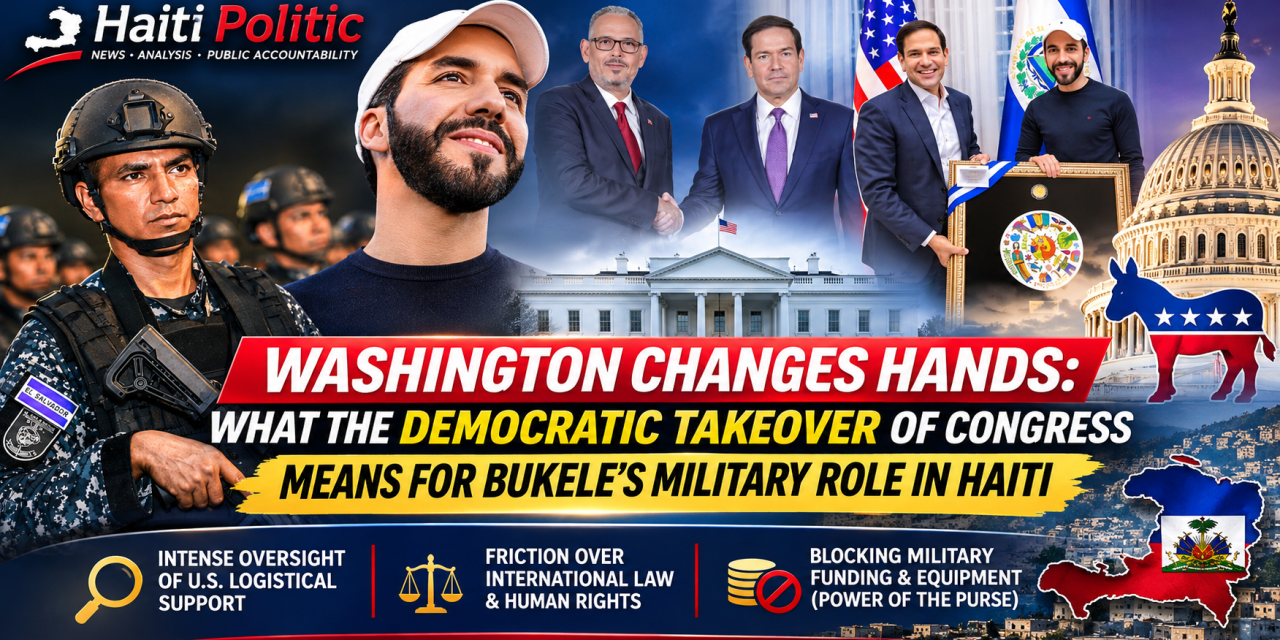
WASHINGTON CHANGES HANDS: WHAT THE DEMOCRATIC TAKEOVER OF CONGRESS MEANS FOR BUKELE’S MILITARY ROLE IN HAITI
The November 3, 2026, U.S. midterm elections have given Democrats control of both chambers of Congress, potentially transforming the political, financial, and legal environment surrounding American support for El Salvador’s security involvement in Haiti. From congressional investigations to restrictions on military assistance, President Nayib Bukele could face a much less accommodating Washington. But can Congress actually constrain a foreign deployment—and will Haiti gain greater control over its own security?
HAITI POLITIC | GEOPOLITICAL ANALYSIS & INTERNATIONAL SECURITY
November 4, 2026
INTRODUCTION: A POLITICAL EARTHQUAKE IN WASHINGTON, A STRATEGIC WARNING FOR SAN SALVADOR
The November 3, 2026, U.S. midterm elections have produced a major shift in American political power.
Democrats have secured control of both the House of Representatives and the Senate, according to projections reported by major American news organizations.
For President Donald Trump, the result introduces a new period of divided government.
For Salvadoran President Nayib Bukele, it could complicate a foreign-policy relationship that has depended heavily on cooperation with the Trump administration.
And for Haiti, the consequences may extend directly into the international security arrangements operating on its territory.
The immediate question is not whether Democrats can order Salvadoran soldiers to leave Haiti.
They cannot.
El Salvador is a sovereign country, and the U.S. Congress does not directly command its armed forces.
The more consequential question is whether Congress can restrict the American money, equipment, logistical assistance, intelligence cooperation, and diplomatic support that could help sustain Salvadoran operations.
The answer is yes—within important constitutional and statutory limits.
A Democratic Congress could investigate U.S. involvement, demand operational records, scrutinize human-rights compliance, and legislate restrictions on certain categories of foreign assistance.
However, the newly elected Congress does not assume office until January 3, 2027. Until then, the existing Congress retains its legislative authority.
Furthermore, Democrats’ control of both chambers does not automatically guarantee that every proposed restriction will become law. President Trump retains the veto, and overcoming a presidential veto generally requires a two-thirds majority in both chambers.
Nevertheless, the political environment surrounding Bukele’s involvement in Haiti has changed.
The central question is whether that change will produce greater accountability—or simply another struggle in Washington over who controls Haiti’s security policy.
1. FIRST, UNDERSTAND THE MILITARY FRAMEWORK: IS BUKELE OPERATING UNILATERALLY?
Before evaluating the election’s consequences, an essential distinction must be established.
El Salvador has participated in international discussions and arrangements concerning Haiti’s Gang Suppression Force.
In August 2025, El Salvador joined Canada, Guatemala, Jamaica, Kenya, The Bahamas, and the United States in supporting the framework associated with the Standing Group of Partners for the GSF.
United Nations Security Council Resolution 2793, adopted in September 2025, established the international framework for the GSF and created the United Nations Support Office in Haiti (UNSOH).
The Standing Group of Partners has responsibilities involving strategic coordination, resource mobilization, and political oversight.
Operational command, however, rests with the force commander.
On September 29, 2026, the Security Council adopted Resolution 2829, extending the GSF mandate until March 31, 2027.
That resolution also continued logistical and operational support through UNSOH.
These arrangements matter because the GSF is not legally identical to a unilateral Salvadoran military intervention.
A Salvadoran military deployment operating within the GSF framework must be distinguished from an independent operation conducted outside that framework.
If Salvadoran personnel act under the GSF’s authorized command and operational arrangements, their activities should be evaluated against the mission’s mandate and applicable legal obligations.
If Salvadoran forces conduct separate operations outside that structure, additional questions arise about authorization, command responsibility, legal status, and accountability.
At present, publicly available documentation does not establish the existence of a separate, comprehensive Bukele-controlled military campaign operating entirely outside the international framework.
But Congress could investigate whether actual operational practices match the publicly described command structure.
That distinction could become the foundation of the next phase of American oversight.
2. INTENSE CONGRESSIONAL OVERSIGHT: WHO IS REALLY SUPPORTING BUKELE’S OPERATIONS?
The first major consequence of Democratic control of Congress could be a significant increase in oversight.
Congress possesses broad authority to investigate federal spending, executive-branch conduct, and the implementation of American foreign policy.
House and Senate committees can request documents, hold hearings, question administration officials, and issue subpoenas within their lawful jurisdiction.
This creates several potential areas of investigation.
American logistical assistance
Congress could ask whether the United States is providing logistical support connected to Salvadoran participation in Haiti.
Such support could potentially include transportation, communications equipment, maintenance, operational planning, or other assistance.
The existence and extent of any particular support arrangement must be established through official records rather than assumed.
Lawmakers could request documentation showing which federal agencies authorized assistance, how much it cost, and whether it complied with applicable appropriations restrictions.
Intelligence cooperation
Congress could also examine whether American intelligence is being shared with Salvadoran authorities in connection with operations in Haiti.
Relevant questions could include the legal basis for information sharing, safeguards against misuse, and procedures for protecting civilians.
Military equipment and transfers
Another area of scrutiny would involve equipment supplied to El Salvador through American security-assistance programs.
Congress could investigate whether equipment originally provided for domestic security, humanitarian operations, or other authorized purposes has been used in Haiti.
The central issue would be whether any such use was authorized and consistent with applicable end-use restrictions.
Congressional hearings
A Democratic majority could summon officials from the Department of State, Department of Defense, and other agencies to explain American policy.
Lawmakers could demand answers about mission objectives, financing, civilian protection, and the relationship between the GSF and Haitian authorities.
The political significance is substantial: an operation that previously received limited public scrutiny could become the subject of sustained congressional investigation.
However, congressional investigations would not themselves prove wrongdoing.
Their purpose would be to establish what assistance exists, whether it is lawful, and whether it produces measurable results.
3. THE POWER OF THE PURSE: CAN DEMOCRATS BLOCK U.S. MILITARY SUPPORT?
The most consequential instrument available to Congress is its constitutional authority over federal appropriations.
Congress determines how federal money may be appropriated and can impose statutory conditions on its use.
That authority could become particularly important if the Trump administration seeks to support Salvadoran operations through American security-assistance accounts.
Potential funding mechanisms requiring examination include Foreign Military Financing (FMF), other foreign-security assistance, transfers of equipment, and applicable Defense Department authorities.
But these programs are not interchangeable.
Each operates under specific legal requirements.
A transfer permitted under one authority may not be permitted under another.
Congress could impose restrictions
A Democratic Congress could attempt to prohibit the use of designated appropriations for Salvadoran military operations in Haiti unless specified conditions are satisfied.
Possible conditions could include proof of Haitian government consent, compliance with applicable international law, civilian-protection measures, and detailed financial reporting.
Lawmakers could also require certification that assistance is being used exclusively for authorized purposes.
Congress could restrict transfers
Legislation could seek to prevent certain U.S.-funded equipment or services from supporting operations that fall outside an approved international framework.
Congress could also require advance notification before specified transfers.
Congress could require independent audits
Appropriations legislation could mandate regular reporting on expenditures, contractors, equipment, and operational outcomes.
That could help establish whether American resources are supporting the Haitian National Police, the GSF, Salvadoran personnel, or other entities.
But there are limits
A Democratic majority cannot automatically cancel every existing funding commitment.
Previously appropriated funds may remain legally available under existing statutes.
The executive branch may retain discretion under certain authorities.
And new restrictive legislation would generally require presidential approval or sufficient votes to override a veto.
Therefore, congressional control creates significant leverage, not an automatic financial shutdown.
The practical question is whether Democrats can translate oversight concerns into enforceable restrictions that survive negotiations with the White House.
4. A CRITICAL DETAIL: U.S. LAW ALREADY RESTRICTS CERTAIN MILITARY AID TO EL SALVADOR
The debate does not begin from zero.
According to an October 2026 Congressional Research Service report on El Salvador and U.S. relations, Congress has imposed restrictions on certain categories of American assistance to the Salvadoran government.
For fiscal year 2026, Section 7045(b)(2) of the relevant appropriations legislation required the State Department to withhold 50% of specified assistance until the Secretary of State certified compliance with conditions concerning corruption, human rights, migration, and related issues.
The State Department issued the relevant certification in July 2026.
More importantly, the legislation also prohibited Foreign Military Financing assistance to El Salvador, except for programs supporting humanitarian assistance and disaster response.
That restriction is directly relevant to the Haiti debate.
It means lawmakers do not necessarily need to invent an entirely new legal framework to scrutinize military assistance.
They can examine whether existing restrictions are being followed and whether future legislation should preserve or strengthen them.
However, an FMF restriction does not automatically prohibit every possible form of U.S. logistical or security cooperation.
Other programs have separate statutory authorities.
The Congressional Research Service also reported that a House-passed fiscal year 2027 appropriations bill did not contain the same Salvadoran restrictions.
This creates an important political question for the incoming Congress:
Will Democrats restore, strengthen, or expand restrictions on American military assistance to El Salvador?
And if they do, will those restrictions specifically address activities connected to Haiti?
The answers could significantly affect the financial environment surrounding Bukele’s international security role.
5. HUMAN RIGHTS: BUKELE’S SECURITY MODEL COULD FACE A DIFFERENT STANDARD OF SCRUTINY
Bukele has built his international political reputation around an aggressive campaign against criminal gangs in El Salvador.
His government presents that approach as a major public-security achievement.
Supporters point to dramatic reductions in reported violence and argue that extraordinary measures were necessary to confront entrenched criminal organizations.
Critics have raised concerns about mass detention, due process, prolonged emergency powers, and the treatment of detainees.
Those competing assessments matter when a government associated with that security model participates in operations abroad.
A Democratic Congress could demand stronger safeguards concerning the conduct of Salvadoran personnel in Haiti.
Civilian protection
Lawmakers could ask what operational rules govern the use of force.
They could examine whether procedures exist to distinguish armed gang members from civilians.
Detention and transfer procedures
Congress could seek clarification about what happens when foreign personnel participate in apprehending suspected gang members.
Who takes custody?
Which Haitian institution is responsible for prosecution?
What legal safeguards apply?
Accountability for misconduct
Lawmakers could ask whether allegations involving foreign personnel are investigated by Haitian authorities, the contributing country, the mission’s command structure, or some combination of those institutions.
Human-rights vetting
Certain U.S. security-assistance programs are subject to legal restrictions involving foreign security units credibly implicated in gross violations of human rights.
Congress could examine whether relevant vetting and compliance procedures are being applied.
None of these inquiries automatically establishes that Salvadoran personnel have committed abuses in Haiti.
The issue is whether the international mission has effective safeguards before misconduct occurs—and credible accountability mechanisms if allegations arise.
A security operation cannot be judged only by the number of suspected gang members arrested or killed. It must also be judged by legality, civilian protection, and the capacity of Haitian institutions to administer justice.
6. INTERNATIONAL LAW: HAITI’S CONSENT IS NOT A MINOR TECHNICALITY
The presence of foreign security personnel on Haitian territory raises questions about sovereignty and international authorization.
These questions must be examined carefully.
The GSF operates within a Security Council-authorized framework.
Resolution 2829 also acknowledges an agreement signed on July 27, 2026, between the Haitian government and the GSF concerning the force’s legal status.
That agreement is relevant to the mission’s legal foundation.
However, authorization of the GSF does not mean every conceivable military activity by every participating country is automatically authorized.
The scope of the mandate matters.
The command structure matters.
The agreements governing personnel matter.
And the applicable rules concerning human rights and the use of force matter.
A Democratic Congress could investigate whether American support is connected to activities that remain within the mission’s authorized scope.
If a separate Salvadoran operation were conducted outside the GSF framework, its legal basis would require independent examination.
Such an operation would not automatically be unlawful merely because it was bilateral rather than multinational. Its legality would depend on factors including valid Haitian consent, applicable domestic law, international obligations, and the nature of the operation.
But the existence of an international mission cannot be used as a blanket justification for unrelated activities.
Haiti’s sovereignty must remain central to the legal analysis.
The Haitian government should be able to explain which foreign forces are authorized to operate, under what agreements, and with what limitations.
7. THE REGIONAL RIPPLE EFFECT: BUKele, TRUMP, AND THE FUTURE OF CENTRAL AMERICAN SECURITY DIPLOMACY
The consequences of the American elections could extend beyond Haiti.
Bukele’s international standing has been strengthened by his reputation as a leader willing to pursue aggressive security policies.
His relationship with Washington is important because American diplomatic and security cooperation can influence El Salvador’s regional role.
A change in congressional leadership could alter the incentives surrounding that relationship.
El Salvador may face greater pressure for transparency
Congressional investigations could require the Trump administration to explain how its cooperation with Bukele advances American interests.
That could include questions about detention arrangements, regional security initiatives, and participation in Haiti.
Other regional governments may reassess their commitments
Countries participating in international security arrangements often consider diplomatic backing, funding, operational risks, and domestic political consequences.
If Washington becomes less predictable, governments may seek clearer financial commitments and stronger legal protections before expanding their involvement.
Canada and other partners could become more important
The GSF’s international framework includes several participating governments.
If American support becomes politically contested, other partners may face increased pressure to sustain financial or operational commitments.
That does not mean they would necessarily agree to replace American support.
CARICOM could demand greater Haitian institutional leadership
Caribbean governments have a direct interest in Haiti’s stability.
A more contested American role could create opportunities for renewed discussion about Haitian ownership of security operations, regional diplomacy, and institutional reconstruction.
But those opportunities would depend on actual policy decisions.
The election alone does not guarantee a different international strategy.
8. COULD THE DEMOCRATIC TAKEOVER FORCE BUKELE TO WITHDRAW FROM HAITI?
A withdrawal is possible under certain circumstances, but it is not an automatic consequence of the election.
Several factors would determine whether Salvadoran participation could continue.
First, the legal framework. Operations within the GSF have an international mandate currently extended through March 31, 2027.
Second, Salvadoran political decisions. Bukele’s government ultimately determines its own participation, subject to its domestic legal obligations and international commitments.
Third, financing. If Salvadoran participation depends materially on external resources, restrictions on those resources could affect operational sustainability.
Fourth, logistics. Transportation, communications, medical evacuation, equipment maintenance, and other support arrangements can influence a deployment’s effectiveness.
Fifth, Haitian consent and cooperation. The relationship with Haitian authorities remains essential to the mission’s legitimacy and practical operation.
Sixth, domestic politics in El Salvador. Public support, costs, casualties, and competing security priorities could influence Bukele’s decisions.
Therefore, the more realistic short-term consequence of the Democratic victory is not an immediate withdrawal order.
It is the possibility of greater scrutiny, more conditional support, and increased political uncertainty.
9. THREE POSSIBLE SCENARIOS FOR 2027
SCENARIO ONE: CONGRESS INCREASES OVERSIGHT, BUT THE DEPLOYMENT CONTINUES
Under this scenario, Democrats hold hearings, demand financial records, and seek stronger reporting requirements.
The Trump administration continues supporting the international security framework using available lawful authorities.
Bukele maintains Salvadoran participation.
The main change is increased transparency and political scrutiny.
This scenario would not necessarily reduce the mission’s operational capacity.
It could, however, expose weaknesses in its funding and accountability arrangements.
SCENARIO TWO: CONGRESS IMPOSES NEW FUNDING CONDITIONS
Under a second scenario, Democrats use appropriations negotiations to require specific certifications before designated American assistance can support Salvadoran operations.
Possible conditions include civilian-protection safeguards, financial audits, and proof that activities remain within authorized arrangements.
The White House might negotiate, oppose, or veto such legislation.
If restrictions become law, the administration would have to comply with them.
This scenario could increase pressure on Bukele to demonstrate that his involvement in Haiti meets clearly defined legal and operational standards.
SCENARIO THREE: A MAJOR CONFRONTATION OVER AN INDEPENDENT OPERATION
The most contentious scenario would arise if credible evidence emerged that Salvadoran forces were conducting a separate operation outside the GSF’s authorized command arrangements, with American assistance.
Congress could investigate the legal authority for that support.
Lawmakers could seek restrictions on relevant funds and equipment.
The administration might defend its actions as lawful bilateral security cooperation.
The resulting dispute could involve questions of presidential authority, congressional appropriations powers, and international law.
But this scenario remains conditional.
The available evidence does not establish that such a separate operation currently exists.
10. THE QUESTION HAITI MUST ASK: WHO CONTROLS THE SECURITY STRATEGY?
The American elections raise an uncomfortable question for Haiti.
Why should the future of security operations on Haitian territory depend so heavily on the political balance between Democrats and Republicans in Washington?
Haiti has experienced decades of international security assistance.
The country has received foreign police training, military and logistical support, institutional advisory programs, and successive international missions.
Yet the Haitian National Police continues to face severe operational challenges.
The justice system remains under enormous pressure.
Armed groups have demonstrated an ability to regenerate personnel, acquire weapons, and exploit weaknesses in state institutions.
The central challenge is therefore larger than the identity of the foreign leader providing assistance.
Whether the external partner is the United States, El Salvador, Kenya, Canada, or another country, the same questions apply.
Who defines the mission’s objectives?
Who controls the financing?
Who approves operational decisions?
Who investigates misconduct?
Who determines whether the mission has succeeded?
And what happens when foreign personnel leave?
A strategy that depends indefinitely on external political support is not a substitute for building Haitian institutions.
Haiti needs international cooperation that strengthens national capacity—not arrangements that leave the country’s security dependent on election results abroad.
11. TEN QUESTIONS FOR THE NEW U.S. CONGRESS, BUKELE, AND HAITIAN AUTHORITIES
Questions for the incoming Democratic Congress
1. Will Congress investigate the full extent of American financial, logistical, and intelligence support connected to Salvadoran participation in Haiti?
2. Will lawmakers require public reporting on the use of U.S.-funded equipment by foreign security personnel operating in Haiti?
3. Will Congress preserve or strengthen existing restrictions on military assistance to El Salvador?
4. Will appropriations legislation distinguish support for the UN-authorized GSF from assistance for any separate bilateral military operation?
Questions for President Nayib Bukele
5. What is the precise legal and operational framework governing Salvadoran personnel participating in security activities in Haiti?
6. What are the total costs of Salvadoran participation, and which governments or international mechanisms are financing those costs?
7. What procedures govern civilian protection, detention, the use of force, and investigations into alleged misconduct?
Questions for Haitian authorities
8. What agreements govern Salvadoran personnel operating on Haitian territory, and which provisions can be made public?
9. How are Haitian police, prosecutors, courts, and detention authorities integrated into operations involving foreign personnel?
10. What measurable benchmarks will demonstrate that international assistance is making Haiti less dependent on foreign security forces?
CONCLUSION: WASHINGTON HAS CHANGED. BUT WILL HAITI’S SECURITY STRATEGY CHANGE?
The Democratic takeover of both chambers of Congress represents a major change in American political power.
For President Trump, it means stronger legislative opposition and a greater likelihood of congressional investigations.
For President Bukele, it could mean a more demanding political environment surrounding American cooperation with El Salvador.
For Haiti, it introduces uncertainty into an international security framework that depends on coordination, resources, and sustained political commitments.
Democrats could investigate U.S. logistical support.
They could demand stronger human-rights safeguards.
They could seek restrictions on military financing and equipment transfers.
They could require clearer distinctions between internationally authorized operations and independent bilateral activities.
But none of those outcomes is guaranteed.
The new Congress must first take office.
Lawmakers must decide which issues to prioritize.
And legislative restrictions must overcome the constitutional and political obstacles inherent in divided government.
The most important conclusion is therefore not that Bukele’s role in Haiti is finished.
It is that the American political environment surrounding his international security ambitions may become substantially less permissive.
Yet Haiti should draw a larger lesson.
A country’s national security cannot remain permanently vulnerable to changes in another country’s electoral politics.
The November 3 elections may determine how aggressively Washington scrutinizes Bukele.
They should not determine whether Haiti has a functioning police force, an independent justice system, or the institutional capacity to protect its population.
THE QUESTION HAITI POLITIC IS ASKING
IF A CHANGE IN THE U.S. CONGRESS CAN THREATEN THE FINANCING OR POLITICAL SUPPORT OF FOREIGN SECURITY OPERATIONS IN HAITI, WHAT DOES THAT REVEAL ABOUT HAITI’S DEPENDENCE ON EXTERNAL POWERS?
And if the international community has repeatedly promised to strengthen Haitian security institutions, why does the country remain so dependent on the decisions of foreign governments?
WASHINGTON MAY CONTROL ITS FOREIGN ASSISTANCE BUDGET. BUKELE MAY CONTROL EL SALVADOR’S MILITARY POLICY. BUT HAITI MUST RETAIN AUTHORITY OVER ITS OWN NATIONAL SECURITY.
Foreign assistance can support that objective.
It cannot replace it.
HAITI POLITIC | GEOPOLITICS, SOVEREIGNTY & INTERNATIONAL ACCOUNTABILITY
SOURCES AND REFERENCE DOCUMENTS
1. Associated Press — November 3–4, 2026 Midterm Election Results
Reporting on the Democratic takeover of the U.S. House and Senate.
2. Reuters — November 4, 2026
Democrats Seize Congress in Sweeping Midterm Repudiation of Trump.
3. Congressional Research Service — El Salvador in Brief: Overview and U.S. Relations, October 2026
Analysis of U.S.–Salvadoran relations, foreign assistance, human-rights conditions, and restrictions on Foreign Military Financing.
4. United Nations Security Council Resolution 2793 (2025)
Authorization of the Gang Suppression Force and establishment of the United Nations Support Office in Haiti.
5. United Nations Security Council Resolution 2829 (2026)
Extension of the GSF mandate until March 31, 2027, and acknowledgment of the July 27, 2026, agreement between Haiti and the GSF.
6. United Nations Support Office in Haiti — September 29, 2026
Official announcement concerning renewal of the GSF and UNSOH mandates.
7. United States Code, Title 22, Section 2412
Statutory provisions concerning limitations on foreign-assistance appropriations.