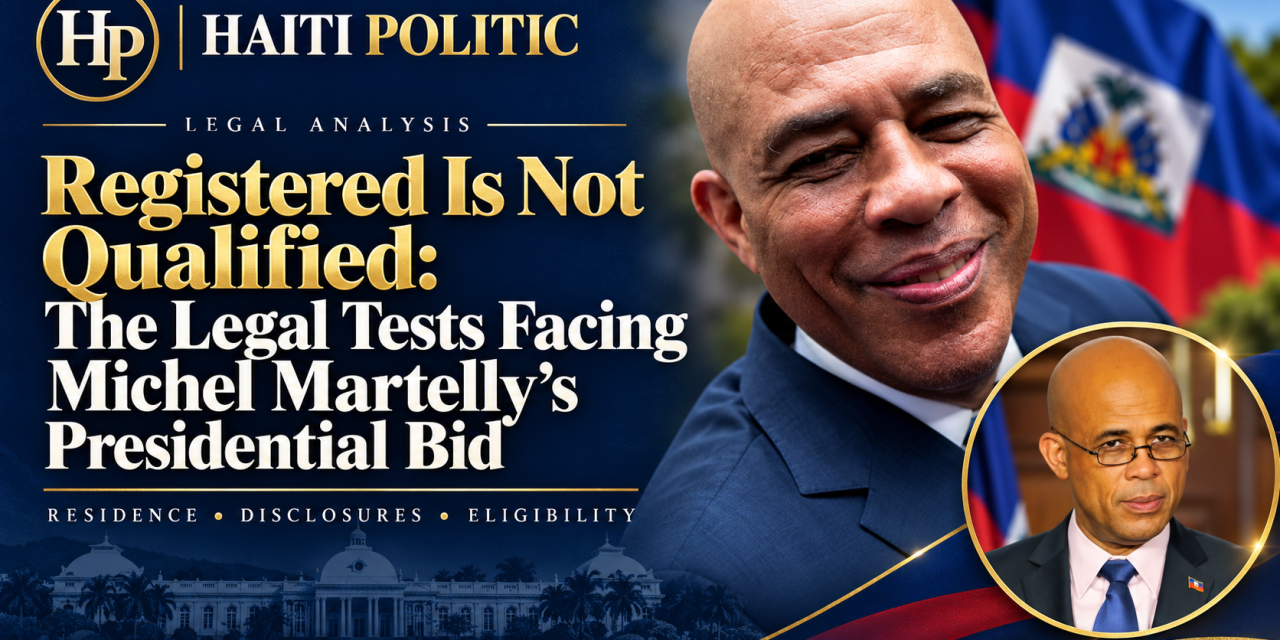
The former president’s name appears in the CEP registration system. That does not resolve the five-year residence requirement, establish compliance with financial disclosure rules, or amount to a final eligibility decision.
Michel Martelly’s entry into Haiti’s presidential registration process raises a question more consequential than whether his name appears on a website: can he satisfy the legal requirements to reach the ballot?
The CEP screenshots supplied to Haiti Politic list “MARTELLY / JOSEPH MICHEL” for president under DEBLOKE. Reporting published October 17 also describes his online registration the previous day. Those records support describing him as a registered presidential aspirant. They do not, by themselves, show that election authorities have examined and approved his complete dossier or resolved challenges. [1]
The answer requires reading Haiti’s amended Constitution alongside the electoral decree published October 6, 2026, in Le Moniteur, Special No. 50. The CEP’s legal framework identifies that revision after the June 2 decree and July 2 amendments. Relying only on an earlier version can produce the wrong answer, particularly on sanctions. [2]
The principal distinction: the five-year residence rule is a genuine constitutional test. Whether Martelly satisfies it requires evidence. His U.S., Canadian and EU sanctions are documented, but those designations are not automatically the UN Security Council sanctions bar retained in the October decree.
What the Constitution requires
Article 135 of the amended Constitution establishes six baseline conditions for election to the presidency. The nationality rule refers to status at registration; the age and residence provisions use the election date. [3]
| Requirement | What must be established |
|---|---|
| Haitian nationality of origin | The candidate must be Haitian by origin and hold no other nationality at registration. |
| Minimum age | At least 35 on election day. |
| Civil and political rights | Enjoy those rights and have no conviction carrying the specified “afflictive and infamous” penalty for an ordinary criminal offense. |
| Property and habitual residence | Own at least one immovable property in Haiti and maintain habitual residence in the country. |
| Five consecutive years of residence | Reside in Haiti for five consecutive years before the election date. |
| Discharge for public accounting | Obtain a discharge of management if the candidate has been accountable for public funds. |
These are cumulative conditions. Passing one does not excuse failure on another.
The October decree adds eight eligibility conditions
Article 76 expressly applies in addition to Constitution Article 135. Its eight conditions are:
- Hold a valid national identification card.
- Be entered in the electoral register.
- Be in good standing with the tax authorities.
- Possess the required asset declarations if previously an authorizing officer or accountant of public funds.
- Never have been found guilty of electoral fraud.
- Never have been subject to administrative measures by the CEP.
- Never have been dismissed by a public administration institution within the meaning of Article 199 of the May 17, 2005 public service decree.
- Not be subject to UN Security Council sanctions.
This is the October text, not the earlier nine-condition summary still found on some reference pages. It does not replace the constitutional requirements. [4, printed p. 20]
What must appear in the application file?
Eligibility and documentation are related but distinct. Article 153 requires supporting records, including identity and birth documents; a notarized property title for presidential applicants; an Immigration and Emigration certificate addressing foreign passports or other documents recorded in its database; a criminal-record certificate issued within six months; a notarized declaration concerning the specified criminal convictions; a negative police certificate; and a residence or domicile attestation supported by a justice-of-the-peace report.
It also requires applicable party designation, public-service resignation or leave documents, proof of ending incompatible state-concession roles, a discharge where required, applicable asset declarations, DGI attestations for the previous five years of tax obligations, a fee receipt, the signed CEP form, photographs and a CV. Not every role-dependent document applies to every person. Independent presidential candidates face an additional supporter-list requirement; registration under a political structure must not be confused with that independent route. [4, printed pp. 32–34]
Article 157 sets the standard presidential registration fee at two million gourdes, with reductions addressed elsewhere in the decree. Payment purchases neither a waiver nor an eligibility ruling. Article 155 provides for rejection of a file missing a required document. [4, printed p. 34]
The potential barriers Martelly must answer
1. Five consecutive years of residence: the clearest issue for examination
In July 2026, Associated Press reporting described Martelly as living in the United States and returning to Haiti on a rare visit. That is a substantial reason to examine his compliance with Article 135’s residence provisions. It is not a complete record of where he lived throughout the relevant five-year period. [5]
If the competent electoral authorities establish that he did not satisfy the required five consecutive years before election day, that would be a substantive constitutional obstacle. Registering online or returning shortly before an election does not, on its own, establish five years of residence.
A rigorous review should examine immigration and travel records, residence attestations and their supporting reports, tax filings, and other evidence of where he actually maintained his residence. The applicable interpretation must distinguish residence from occasional travel: the constitutional language should not be casually converted into a claim that every trip abroad automatically disqualifies someone.
The five-year period must be measured against the legally applicable election date, not simply the date of registration. A property title establishes ownership; it does not by itself establish five years of residence. Likewise, a current domicile certificate should not be treated as conclusive proof of an entire historical period without examining its basis.
2. Required discharge of public-fund management
Article 135’s discharge condition and Article 153’s supporting-document provision require scrutiny where a candidate has served in a qualifying public-fund role. For a former president, the proper question is which accounting or management obligations legally applied, and what valid discharge documentation is required and supplied.
An applicable discharge requirement left unsatisfied could obstruct a candidacy. But neither the title “former president” nor the absence of a certificate from a news story establishes the answer. Haiti Politic has not reviewed Martelly’s full dossier or an authoritative determination of his discharge status. A missing document in this article is not proof that it is missing from his file.
3. Tax compliance and asset declarations
The October decree retains tax compliance and applicable asset declarations. Article 153 separately requires DGI attestations concerning the previous five years and certified asset-declaration copies where applicable.
Failure to meet these requirements could justify rejection. Allegations of financial misconduct, however serious, do not substitute for examining the actual records. This review has not established that Martelly lacks the required attestations or declarations. A tax compliance attestation and a discharge of public-fund management serve different purposes; neither should be presented as an automatic substitute for the other.
4. Nationality, property and the accuracy of supporting records
The CEP must verify the same nationality, property and residence requirements for Martelly that it applies to other applicants. Living abroad does not itself prove foreign citizenship. A foreign address is not proof of naturalization, and this article has no evidence establishing that he currently holds another nationality.
These are mandatory verification points, not established violations by Martelly. Any challenge must identify the actual unmet condition and supporting evidence.
5. Disqualifying findings or false declarations—if established
A qualifying criminal conviction, loss of relevant rights, electoral-fraud finding, covered CEP administrative measure or public-service dismissal could engage the applicable restrictions. But this review has not established such a disqualifying finding against Martelly.
Accuracy of the filing is independently important. Article 163 provides for cancellation of a candidacy based on a false declaration and for invalidation if a false declaration is revealed and verified after election, without prejudice to the decree’s criminal sanctions. That is a legal consequence to explain, not an accusation that Martelly has submitted a false declaration. [4, printed p. 35]
Why the sanctions do not settle the legal question
The sanctions are real and serious. Canada listed Martelly in November 2022. The U.S. Treasury imposed sanctions August 20, 2024, citing his alleged contribution to illicit drug trafficking. The European Union listed him December 15, 2025, under its Haiti measures. These are governmental sanctions determinations, not interchangeable with criminal convictions. [6] [7] [8]
The October text does not retain the earlier Article 153 BRH-certificate provision that extended the screening to specified foreign sanctions. It does retain the Article 76 UN Security Council bar. A U.S., Canadian or EU designation cannot simply be relabeled a UN designation.
A check of the UN consolidated sanctions XML generated October 16, 2026, at 23:00 UTC found no Martelly entry. The Haiti entries in that file include nine individuals, including Dimitri Hérard and Kempes Sanon. The underlying list should be checked again when an eligibility decision is made. Mention in a UN expert report is also different from formal designation on the sanctions list. [9]
Foreign sanctions therefore remain relevant to political judgment and may impose practical restrictions on financial transactions or travel under their respective regimes. They are not, by themselves, proof that he fails the specific UN-sanctions condition in the October decree.
What is not a valid automatic objection?
Having already served one presidential term does not automatically prevent a second. Constitution Article 134.3 requires a five-year interval before another term and prohibits a third. Martelly served from 2011 to 2016; the interval alone is not an apparent obstacle to a new bid in this cycle. Nor does being a former singer create a legal disqualification. His age is not an apparent barrier either: official sanctions records give a February 12, 1961 birth date. [3] [10]
These distinctions matter because a credible challenge should rest on the strongest evidence and the rule actually in force. Political unfitness and legal ineligibility are different questions.
Registration begins a process; it does not finish it
Articles 164–165 address preliminary approved lists after processing. Article 166 allows voters to challenge candidacies with evidence; Articles 172–174 address investigation, defense and adjudication. Article 176 provides for publication of the final approved list after file review, challenges and inquiries. [4, printed pp. 35–36]
Haiti Politic has not reviewed a final CEP ruling approving or rejecting Martelly, his complete supporting dossier, or a decided challenge to his current candidacy. The supplied registration screenshots are not those documents.
The questions the CEP should answer are concrete: What evidence supports five years of residence? What required financial and discharge records were supplied? Were the documents authenticated? Were any challenges filed, and how were they decided?
Martelly’s registration is a political development. Qualification is a legal determination that still must be supported by the record. His former office does not excuse compliance, and public outrage does not replace proof. The same legal tests should apply to every candidate.