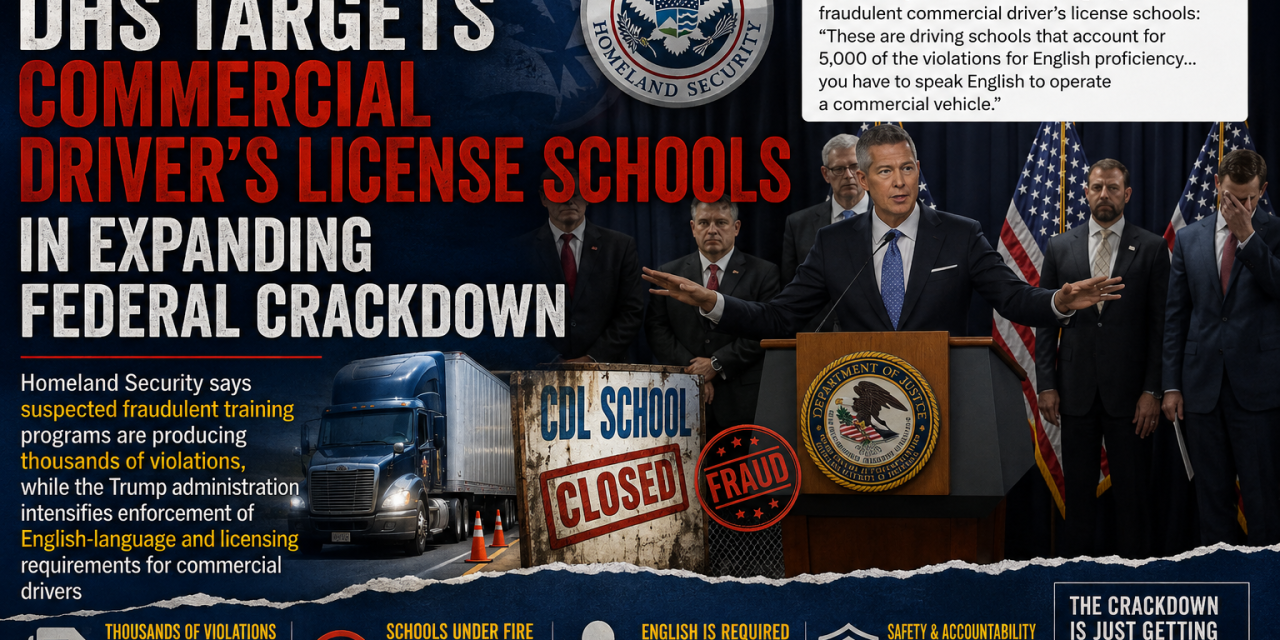
Homeland Security says suspected fraudulent training programs are producing thousands of violations, while the Trump administration intensifies enforcement of English-language and licensing requirements for commercial drivers
WASHINGTON — August 31, 2026 — Haiti Politic
The U.S. Department of Homeland Security is escalating a federal crackdown on commercial driver’s license training schools, with officials alleging that questionable programs have contributed to thousands of violations involving drivers who may not meet federal requirements—including English-language proficiency standards.
In a social-media post shared Monday, Homeland Security quoted U.S. Transportation Secretary Sean Duffy as announcing the “emergency closure of fraudulent commercial driver’s license schools.”
“These are driving schools that account for 5,000 of the violations for English proficiency,” Duffy says in the video accompanying the DHS post. “You have to speak English to operate a commercial vehicle.”
The announcement represents the latest development in a much broader federal campaign targeting commercial-driver training, licensing practices and foreign drivers. For Haitian immigrants and other immigrant communities with a significant presence in transportation and trucking, the enforcement push deserves particularly close attention.
DHS and Transportation Department Join Forces
The current crackdown did not begin this week.
In July, DHS announced that Homeland Security Investigations, or HSI, would partner with the Department of Transportation’s Federal Motor Carrier Safety Administration to investigate suspected fraud involving commercial driver’s license schools.
At the time, federal officials said approximately 75 entry-level driver-training schools had been identified for investigation over suspected practices including improper driver certifications, falsification of training records and failures to adequately train CDL applicants.
The federal government specifically said the investigation would examine fraud connected to the issuance of non-domiciled commercial driver’s licenses, while HSI, FMCSA and state and local authorities would work together on the investigations.
The administration describes the effort as a public-safety initiative intended to ensure that people operating large commercial vehicles are properly trained and qualified.
English Proficiency Has Become a Major Enforcement Issue
English proficiency is increasingly at the center of the administration’s commercial-driving policy.
Federal requirements are intended to ensure commercial drivers have sufficient English proficiency to understand road signs, communicate with law-enforcement officials and respond to official inquiries.
Earlier this year, the administration also moved toward requiring CDL knowledge and skills testing to be conducted in English. An Associated Press report noted that some states had previously permitted commercial-license examinations in multiple languages even though commercial drivers were separately subject to English-proficiency requirements.
Federal officials have since been aggressively enforcing those standards.
When DHS and DOT announced their joint investigation in July, Duffy said the administration had already removed more than 24,000 commercial drivers from the roads for failing English-language requirements, forced states to cancel more than 28,000 licenses that the administration says were improperly issued to foreign drivers, and removed more than 9,500 training schools from FMCSA’s registry.
Those are administration figures and should be understood as such; they do not by themselves establish that every affected driver or school engaged in fraud.
Fraud and English Proficiency Are Not the Same Thing
That distinction is particularly important.
A driver failing an English-proficiency requirement is not necessarily evidence that the driver obtained a license fraudulently. Likewise, an immigrant or foreign-born driver is not inherently an improperly licensed driver.
The federal investigation of schools involves separate allegations such as falsified training records, improper certifications and inadequate instruction.
There is also a legitimate policy debate over whether the administration has demonstrated a direct connection between immigrant drivers, English proficiency and increased highway danger.
Reporting on trucking-school oversight has noted that Duffy has cited immigrant drivers and English proficiency as important safety concerns, while critics say the administration has not produced comprehensive evidence establishing that immigrant drivers who lack English proficiency are systematically more dangerous than other commercial drivers.
At the same time, fraudulent CDL schools are not merely a theoretical problem. Previous federal prosecutions have involved school operators and others accused of helping unqualified applicants obtain commercial licenses, including schemes in which applicants allegedly received licenses without properly completing required examinations.
The policy question, therefore, is not simply whether fraud exists. It is whether enforcement accurately distinguishes actual fraud and unsafe driving from immigration status and language proficiency.
The Crackdown Is Already Reaching Drivers
The federal effort extends beyond training schools.
DHS and DOT have been conducting broader commercial-vehicle enforcement operations under Operation Highway Shield.
Recent enforcement resulted in hundreds of drivers or vehicles being placed out of service, while authorities also cited drivers for English-language deficiencies. Earlier enforcement in Florida included more than 3,300 inspections, 176 drivers placed out of service, 35 arrests and 42 people taken into federal immigration custody, according to government figures reported this month.
That overlap between transportation enforcement and immigration enforcement is significant.
A routine trucking inspection can potentially expose questions not only about a CDL, vehicle or English proficiency, but also—depending on the circumstances—about a driver’s immigration status.
Why Haitian Drivers Should Pay Attention
For Haitian immigrants working as truck drivers, bus drivers, delivery operators or other commercial vehicle operators, the policy shift could have practical consequences.
The DHS post does not say that Haitian drivers are being specifically targeted, and there is no evidence in the material reviewed by Haiti Politic that the newly announced school closures are aimed specifically at Haitians.
But Haitian CDL holders fall within an immigrant workforce operating under a significantly tougher federal enforcement environment.
Drivers should therefore understand the difference between possessing a state-issued CDL and satisfying all federal requirements governing commercial driving. A license alone may not prevent enforcement action if federal inspectors determine that another qualification requirement has not been met.
The stakes are particularly high because commercial driving has provided an economic pathway for many immigrant families: obtaining a CDL can open access to jobs that do not require a university degree while offering considerably higher earnings than many entry-level service-sector occupations.
The federal government’s new approach means the institutions providing that pathway are themselves now under scrutiny.
The Questions DHS Still Needs to Answer
Monday’s social-media announcement raises important questions that cannot be answered from the post alone.
Which schools are being closed? Where are they located? How many students received training through them? What specific evidence establishes that each school committed fraud? What does the referenced figure of approximately 5,000 English-proficiency violations represent, and over what period were those violations recorded?
Most importantly, what happens to drivers who received legitimate training or licenses through a school that is subsequently removed from the federal registry?
The earlier DHS announcement identified approximately 75 schools suspected of fraudulent activity, but suspicion and a completed finding of fraud are not interchangeable.
Those distinctions matter when people’s licenses, employment and livelihoods are potentially at stake.
A Transportation Policy With Immigration Consequences
What began as an effort to tighten commercial-driver safety standards has evolved into something considerably larger: a coordinated enforcement system involving the Transportation Department, FMCSA, Homeland Security Investigations, state authorities and, in some operations, immigration enforcement.
The administration says the objective is straightforward—remove unsafe drivers, shut down fraudulent schools and protect motorists.
Few people would dispute that someone operating an 80,000-pound tractor-trailer should be properly trained and capable of safely navigating American roads.
But the more difficult question is how the government determines who is unsafe.
As Washington moves from inspecting individual drivers to investigating—and now reportedly closing—entire training institutions, the consequences will extend well beyond the schools themselves.
For immigrant communities, including Haitian commercial drivers, the issue to watch is whether this remains a targeted campaign against demonstrable licensing fraud and unsafe driving—or becomes a much broader immigration enforcement mechanism operating on America’s highways.
Haiti Politic will continue monitoring DHS and Department of Transportation announcements for the names and locations of affected CDL schools and any information indicating an impact on Haitian drivers.