First removal flight since Supreme Court cleared termination lands deportees in Cap-Haïtien, a country the UN says is buckling under gang violence and mass displacement
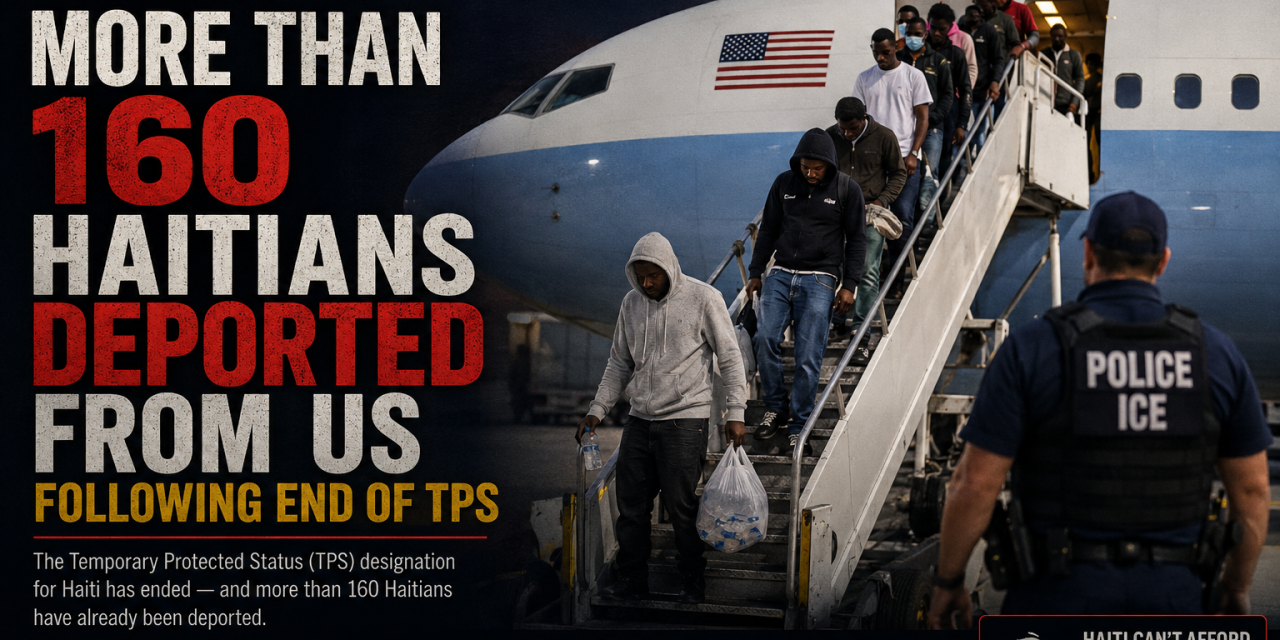
More than 160 people were deported from the United States to Haiti on Thursday, August 20, marking the first removal flight to the country since the Trump administration won its legal fight to end Temporary Protected Status for roughly 350,000 Haitian nationals.
The flight, which originated in Alexandria, Louisiana, carried 161 deportees and landed in Cap-Haïtien in northern Haiti rather than the capital, Port-au-Prince — whose main international airport remains closed to U.S. commercial traffic through early September because armed gangs control large stretches of the city and its surrounding routes. It was the eighth deportation flight to Haiti so far in 2026, but the first since TPS protections formally lapsed, and comes after the U.S. had conducted roughly only one such flight since December 2023.
Jean Négot Bonheur Delva, director general of Haiti’s National Office of Migration, said the group included both Haitians who had served prison sentences in the U.S. and TPS holders who had been living and working legally in the country, some since the program’s earlier phases beginning in 2010. Deportees arrived dressed in white, with many covering their faces from journalists as they disembarked.
The Legal Path That Got Here
The removal flight follows the U.S. Supreme Court’s June 2026 ruling in Mullin v. Doe, in which the justices held that the decision to terminate a country’s TPS designation falls largely within the executive branch’s sole discretion and is not subject to most forms of judicial review. DHS Secretary Kristi Noem had announced the termination in November 2025, acknowledging continued violence in Haiti but concluding conditions no longer met the legal standard for “extraordinary and temporary” circumstances justifying protection. Haiti’s TPS designation dated back to 2010, created in the aftermath of the earthquake that killed more than 200,000 people, and had been repeatedly renewed in the years since.
Landing in a Country in Crisis
The deportees arrived in a country the United Nations describes as facing a severe and worsening security and humanitarian crisis. Gangs control an estimated 70 to 85 percent of Port-au-Prince, and UN figures put the death toll from gang violence at more than 3,100 people killed and roughly 1.5 million people internally displaced between January and June of this year alone. A UN-backed Gang Suppression Force, created in September 2025 to help Haitian police confront the coalitions controlling the capital, has yet to reach full deployment.
Advocacy groups monitoring migration in the region noted that Haiti was already absorbing large numbers of returnees before this flight — more than 140,000 Haitians were deported from neighboring countries, including the Dominican Republic, in just the first half of the year. One migrant rights group said no adequate government assistance measures exist for returnees, many of whom lose ties built over years in the U.S. and face family separation as a result of removal.
What Comes Next
DHS officials have defended the termination as a return to the program’s original intent. General Counsel James Percival has argued TPS had effectively functioned as an unauthorized path to permanent status well beyond what Congress intended when it created the program. Immigration attorneys and advocates have countered that removing protection now, while Haiti’s security situation remains acute, exposes returnees to serious danger — attorneys involved in the underlying litigation have pointed specifically to the risk of kidnapping, since armed groups in Haiti often assume anyone returning from the U.S. has money.
Haitian-American communities in South Florida — home to the largest concentration of Haitian TPS holders in the country, along with sizable communities in New York, Massachusetts, and Georgia — have expanded know-your-rights programming in response. Some local elected officials have publicly criticized the administration’s decision, though immigration and deportation policy is set exclusively at the federal level, leaving state and local officials with no direct authority to reverse it. Congressional Democrats, joined by a small number of Republicans, are backing legislation — S. 4814 in the Senate and a companion bill in the House that has already gathered 218 discharge-petition signatures — that would extend Haiti’s TPS designation through early 2029, though its path to a floor vote remains uncertain.
For now, deportation flights to Haiti are expected to continue, with reports indicating the administration is planning to increase frequency to twice weekly. Whether that pace proceeds as outlined will shape how many of the roughly 350,000 Haitians who lost status this summer face removal to a country still without a functioning international airport in its own capital.