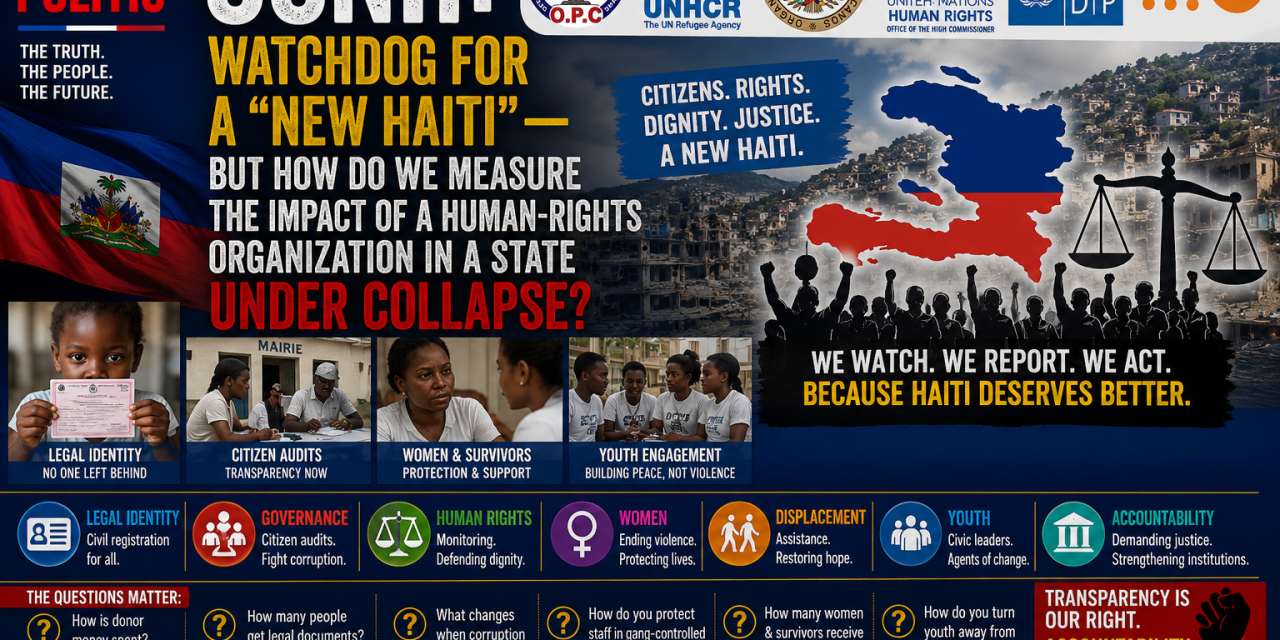
🇭🇹 HAITI POLITIC | CIVIL SOCIETY INVESTIGATION
Human rights. Legal identity. Corruption. Women. Displacement. Youth. Governance. Accountability.
The Organisation des Citoyens pour une Nouvelle Haïti (OCNH) is not a political party.
It does not field presidential candidates.
It does not command a police force.
And it does not control a ministry.
Yet organizations like OCNH can influence Haitian politics in another way: by documenting abuses, challenging public institutions, assisting vulnerable populations, training citizens, and demanding that the state obey its own laws.
Founded in Port-au-Prince on May 1, 2013, OCNH describes itself as an apolitical, nonprofit human-rights organization working on human rights, good governance, anti-corruption, violence prevention and access to legal identity. Its current website lists two principal locations—Port-au-Prince and a regional office in Ouanaminthe—rather than enough public information to independently confirm the five-department organizational footprint described in the prompt.
So the question for Haiti Politic is different from the questions we ask candidates:
CAN A CIVIL-SOCIETY WATCHDOG PROVE THAT ITS REPORTS, DONOR PARTNERSHIPS AND ADVOCACY ACTUALLY CHANGE PEOPLE’S LIVES?
This profile examines both the record and the unanswered questions.
🔎 1 | WHAT DOES OCNH ACTUALLY DO?
OCNH’s own institutional material organizes its work around several broad functions:
human-rights monitoring and advocacy, legal and psychosocial assistance, promotion of nonviolence, democratic governance, anti-corruption advocacy, and the right to legal identity.
That description is supported by more than the organization’s own website.
OCNH has submitted material into the UN human-rights system, including a 2021 civil-society submission connected to Haiti’s obligations under the International Covenant on Civil and Political Rights.
It has also participated in Haiti’s Universal Periodic Review process and advocacy concerning gender-based violence, economic and social rights, impunity and rule of law.
That is a meaningful institutional role.
But reports and workshops are not outcomes by themselves.
🎯 THE FIRST QUESTION FOR OCNH:
Which government policy, court practice, administrative reform or measurable protection outcome changed specifically because of OCNH intervention?
That is the standard serious watchdog organizations should welcome.
🏆 2 | A SIGNIFICANT ACCOMPLISHMENT: THE 2024 FRENCH HUMAN-RIGHTS PRIZE
OCNH received major international recognition in December 2024, when it was named one of five recipients of the Human Rights Prize of the French Republic.
The award, administered through France’s National Consultative Commission on Human Rights, recognized projects protecting civilians affected by armed conflict. The official 2024 award material specifically identified OCNH and described a project aimed at supporting internally displaced people, including temporary shelter, psychosocial assistance, medical care and help with longer-term relocation.
This is not merely an OCNH self-description.
It is independently documented recognition from the French human-rights institution.
The award came with a €14,000 grant per laureate.
🎯 THE ACCOUNTABILITY QUESTION:
What happened to that project afterward?
How many displaced families were housed?
How many women received psychosocial assistance?
How much of the €14,000 was spent on direct services?
Was the temporary reception center completed?
Where are the outcome figures?
An award validates the credibility of a proposed project.
It does not automatically prove implementation.
🪪 3 | LEGAL IDENTITY MAY BE ONE OF OCNH’S MOST CONCRETE 2026 RESULTS
One of the strongest verifiable examples of OCNH’s current field work concerns civil registration.
UNHCR reported that in February 2026 it supported a memorandum of understanding between OCNH and the Civil Registry Office of Mont-Organisé to improve access to birth registration in northern and northeastern Haiti.
UNHCR also reported that OCNH conducted mobile birth-registration activity and helped equip the civil-registry office at Capotille with solar power and essential equipment.
A related UNHCR update reports that more than 100 people were registered and received birth certificates the same day during a Capotille mobile campaign.
That is exactly the kind of measurable result an investigative profile should highlight.
Not rhetoric.
Not a conference.
More than 100 people obtained legal identity documents.
For undocumented Haitians, a birth certificate can affect access to schooling, passports, inheritance, voting, employment and other state services.
⚠️ 4 | BUT 100 DOCUMENTS ALSO SHOW THE SCALE OF THE PROBLEM
The achievement should not be exaggerated.
Haiti’s documentation crisis is vastly larger.
UNHCR continues to describe strengthening civil registration and preventing statelessness as an important national protection priority.
So OCNH should publish a much more detailed dashboard:
❓ How many people has it helped obtain:
- birth certificates?
- archive extracts?
- national IDs?
- corrected civil-status records?
- documents for returned migrants?
- documents for displaced children?
And the figures should be broken down by:
department, gender, age, displacement status and month.
That would allow the public to distinguish a promising pilot project from a scalable national solution.
🤝 5 | THE UN PARTNERSHIP IS REAL — SO FOLLOW THE MONEY
The prompt correctly identifies OCNH as a participant in the UN Multi-Partner Trust Fund system.
The UN MPTF Office currently lists OCNH as a participating organization and reports that US$300,000 has been allocated to OCNH since 2016 through one pooled fund.
That is a significant fact.
And it creates a legitimate investigative question.
How was the $300,000 spent?
OCNH should make accessible:
- project budgets,
- donor amounts,
- administrative overhead,
- staff costs,
- local subcontractors,
- field expenditures,
- audit reports,
- procurement records,
- outputs and outcomes.
Not because receiving international money is suspicious.
Quite the opposite.
An organization advocating transparency in government should model exceptional transparency with donor money.
🧾 6 | SHOULD OCNH PUBLISH AUDITED ACCOUNTS?
Yes—especially because anti-corruption is part of its mission.
OCNH has organized anti-corruption civic initiatives, including national student essay competitions and public advocacy aimed at strengthening citizen engagement against corruption.
That creates a simple credibility test.
🎯 QUESTIONS FOR OCNH LEADERSHIP
Where are your audited annual financial statements?
What percentage of spending reaches beneficiaries directly?
What percentage goes to administration?
Who sits on the governing board?
How are executive salaries determined?
Do employees or board members have to disclose conflicts of interest?
Who approves procurement?
Those questions are not attacks.
They are exactly the governance standards OCNH asks the Haitian state to follow.
👩🏾 7 | GENDER-BASED VIOLENCE: FROM ADVOCACY TO SURVIVOR PROTECTION
OCNH has an increasingly visible record on violence against women.
Its own current site says it assists women survivors of violence, displaced persons and returned migrants.
BINUH/OHCHR also documented a concrete intervention in 2024: with UN human-rights support, OCNH produced and disseminated a public-awareness campaign concerning sexual violence associated with gangs in Port-au-Prince.
And OCNH’s 2024 French Human Rights Prize was connected to civilian protection in the context of armed violence.
But survivor protection requires far more than awareness.
🎯 QUESTIONS
How many survivors received legal representation?
How many received psychological care?
How many obtained emergency relocation?
How many cases were referred to prosecutors?
How many reached court?
How many survivors were able to testify safely?
And what happens when the justice system itself cannot reach gang-controlled territory?
Those metrics would reveal whether OCNH is mainly an advocacy organization—or also an operational protection institution.
⚖️ 8 | OCNH AND THE JUSTICE SYSTEM
The organization has also worked on prolonged pretrial detention, one of Haiti’s chronic rule-of-law failures.
In 2023, OCNH convened judicial actors to discuss prolonged and arbitrary detention, with its leadership calling for greater coordination among institutions.
Earlier initiatives included training police personnel on detainees’ rights and human-rights standards.
Those are credible civil-society functions.
But again:
What changed?
How many detainees were released after OCNH intervention?
How many cases were accelerated?
How many police stations adopted new procedures?
How many complaints resulted in discipline?
If OCNH wants to demonstrate impact, its reporting should increasingly move from:
“We organized a workshop”
to:
“This intervention changed these 127 cases.”
🏛️ 9 | WATCHING THE STATE — BUT HOW INDEPENDENT IS THE WATCHDOG?
OCNH describes itself as apolitical.
That status is central to its legitimacy.
A human-rights watchdog must be willing to criticize:
government,
opposition,
business elites,
gangs,
foreign governments,
police,
judges,
political parties,
and international organizations.
The Inter-American Commission on Human Rights documented why that work can be dangerous.
In granting precautionary measures related to OCNH coordinator Camille Occius, the IACHR described repeated threats, harassment and the vandalism of OCNH’s office, including damaged files and stolen computers. The commission noted that the organization’s cases involved state representatives, members of Haiti’s economic elite and foreign companies.
That is significant evidence that OCNH’s work has carried personal risk.
But independence should also be measurable.
Does OCNH have a policy forbidding senior executives from simultaneously holding partisan political positions?
Are donor relationships publicly disclosed?
Does it use identical investigative standards regardless of which political faction is implicated?
Does it publish corrections when reports contain errors?
Does it grant accused officials a right of response before publication?
These are essential questions for any credible watchdog.
📢 10 | WHAT HAPPENS WHEN OCNH FINDS CORRUPTION?
Civil society does not prosecute crimes.
That distinction matters.
OCNH can investigate, report, refer evidence, advocate and monitor.
It cannot legally substitute itself for prosecutors or judges.
Therefore, the prompt’s question about “forcing” prosecution should be reframed.
OCNH cannot force a prosecution.
But it can make institutional inaction harder to hide.
A stronger model would include:
documenting evidence → formally referring it to ULCC/UCREF/prosecutors → publishing the referral date → tracking the case → reporting whether authorities acted.
🎯 QUESTION FOR OCNH:
Will you publish a public referral tracker?
For every corruption or rights case:
- date identified,
- agency notified,
- response received,
- status,
- time elapsed.
That would turn watchdog advocacy into measurable institutional pressure.
🧒🏾 11 | YOUTH MOBILIZATION: DO NOT CONFUSE CIVIC EDUCATION WITH GANG REHABILITATION
The prompt describes “Ambassadors for Peace” and detailed psychological and vocational exit pathways for radicalized youth.
I could not independently verify enough authoritative documentation to present those specific programs as established OCNH operations.
So that claim should remain unverified unless OCNH provides program documentation.
What is documented is broader civic education, nonviolence work and youth anti-corruption participation. OCNH’s institutional mission includes civic education and promotion of peace, and it has run student-centered anti-corruption competitions.
But rehabilitating youths already embedded in armed organizations is a specialized security, psychological and social-service function.
If OCNH claims to do this work, it should publish:
how many participants,
age ranges,
referral protocols,
security safeguards,
psychological professionals involved,
vocational partners,
follow-up rates,
and reintegration outcomes.
The distinction is important.
Teaching civic peace is not the same thing as extracting a teenager from an armed gang.
🗳️ 12 | WHERE DOES OCNH FIT IN HAITI’S POLITICAL SYSTEM?
OCNH is not a political ideology.
It is not left, right, Lavalas, PHTK, socialist, conservative or nationalist by definition.
Its proper place is outside electoral competition.
That independence can make it more valuable than another political movement.
An effective organization like OCNH can pressure any future government on:
human rights, civil documentation, public finance, judicial abuse, displacement, gender violence and corruption.
Its greatest contribution may therefore not be deciding who governs Haiti.
It may be helping ensure that whoever governs is watched.
📊 HAITI POLITIC | OCNH ACCOUNTABILITY MATRIX
| AREA | DOCUMENTED EVIDENCE | QUESTION STILL TO ANSWER |
|---|---|---|
| Human Rights | Monitoring, advocacy, UN submissions and victim assistance are core activities. | How many individual cases produce remedies? |
| Legal Identity | UNHCR documented mobile civil-registration work and Capotille support in 2026. | Can the program scale nationally? |
| Direct Result | More than 100 people received birth certificates during one Capotille campaign. | What is the annual total? |
| UN Funding | MPTF reports $300,000 allocated since 2016 through one pooled fund. | Where are detailed public audits and outcome reports? |
| Gender Violence | OCNH has conducted survivor-related advocacy and gang-sexual-violence awareness work. | How many survivors receive full legal/medical outcomes? |
| International Recognition | 2024 French Republic Human Rights Prize laureate. | What measurable results came from the funded project? |
| Justice Reform | Work on prolonged pretrial detention and police human-rights training. | How many cases or institutional practices changed? |
| Independence | OCNH describes itself as apolitical; leadership has faced documented threats. | Are governance, donor and conflict-of-interest rules fully public? |
🔥 12 QUESTIONS OCNH SHOULD ANSWER PUBLICLY
- What is OCNH’s total annual budget for 2024, 2025 and 2026?
- Who are its ten largest donors?
- What percentage of every donor dollar reaches field programming?
- Where can the public read externally audited financial statements?
- How many Haitians obtained civil documents directly through OCNH-supported interventions in 2025 and 2026?
- How many survivors of gender-based violence received legal, psychological, medical or relocation assistance?
- How many cases reported by OCNH have resulted in prosecution, administrative reform or compensation?
- What security protocols protect OCNH staff operating in high-risk areas?
- How does OCNH verify facts and provide a right of reply before naming individuals or institutions in reports?
- What rules ensure political neutrality among directors, employees and board members?
- What measurable results came from the 2024 French Human Rights Prize project?
- What does success look like by the end of 2027—and which metrics will the public be allowed to judge?
🇭🇹 THE CENTRAL QUESTION
Haiti needs strong institutions.
But while those institutions remain weak, it also needs strong independent organizations willing to watch them.
OCNH has a documented record.
It has existed since 2013.
It has participated in international human-rights mechanisms.
It has collaborated with UNHCR on legal identity.
It has received pooled UN funding.
It has worked on gender-based violence and detention rights.
And it received the French Republic’s Human Rights Prize in 2024.
Those are meaningful credentials.
But civil society should not demand transparency from government while asking the public to accept its own effectiveness on faith.
The next stage for OCNH—and organizations like it—should therefore be:
More public data.
More independently audited finances.
More case outcomes.
More measurable results.
And the same accountability standards for civil society that civil society demands from the state.
OCNH: WATCHDOG FOR A NEW HAITI — BUT WHO WATCHES THE WATCHDOG, AND CAN ITS WORK BE MEASURED?
That is not an argument against OCNH.
It is the accountability test serious democratic institutions should welcome.
THE RECORD. THE QUESTIONS. THE RESULTS. THE PEOPLE DECIDE.
#HaitiPolitic #OCNH #Haiti #HumanRights #CivilSociety #GoodGovernance #Corruption #LegalIdentity #UNHCR #GenderBasedViolence #Accountability #RuleOfLaw #Ayiti