Haiti Politic — Profile
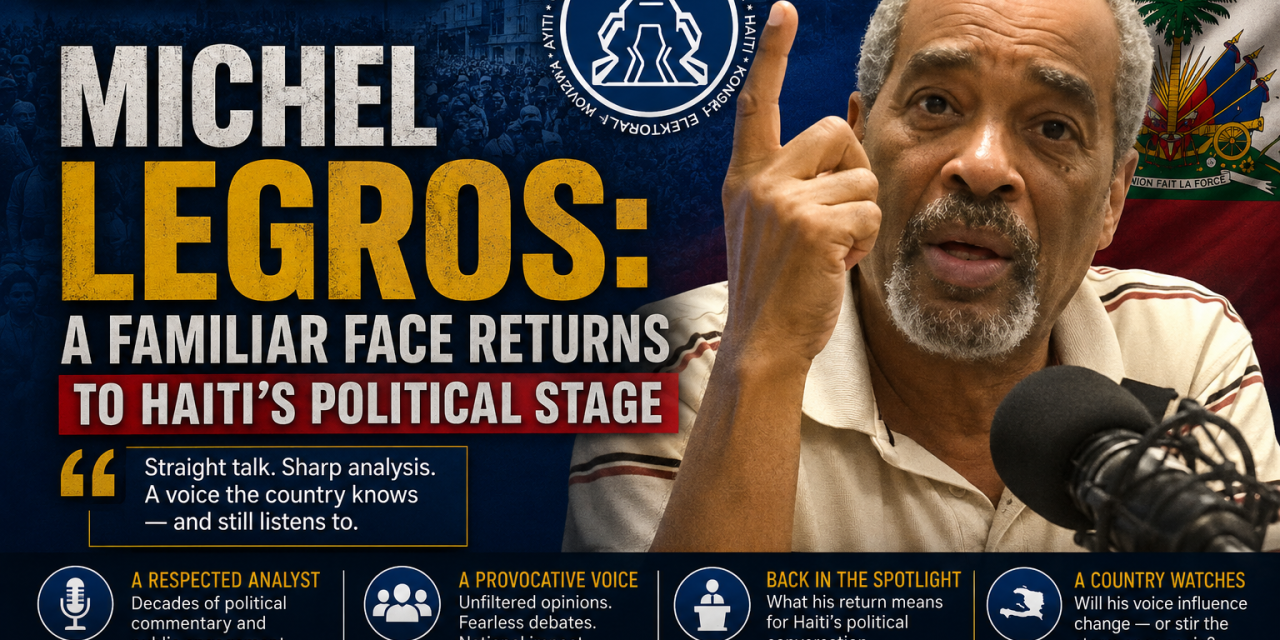
Among the fifteen political groupments approved by Haiti’s Conseil Électoral Provisoire (CEP) on August 8, 2026, one is led by a name Haitians may recognize from an earlier, turbulent chapter of the country’s politics. Michel Legros now represents MYÈL, a coalition of 13 political parties, placing him among the political operators positioning themselves ahead of the country’s next elections.
Not a New Face
Unlike some of the newer entrants into this election cycle, Legros is not a political newcomer. In the days following the assassination of President Jovenel Moïse in July 2021, Haiti’s opposition coalition formed the “Commission de facilitation de la passation du pouvoir” — a body tasked with facilitating dialogue toward an orderly transition of power. Michel Legros was named as one of its members, alongside figures such as attorney Gervais Charles, retired colonel Himmler Rébu, former deputy Hugues Célestin, Antoine Augustin, Jean-André Victor, and writer Gary Victor. The commission’s stated purpose, according to opposition statements at the time, was to help identify credible figures to form a replacement government and, if possible, to engage directly with Moïse on the terms of his departure.
That role placed Legros at the center of one of the most consequential and chaotic moments in recent Haitian political history — a period defined by a power vacuum, competing claims to legitimacy between rival prime ministers, and heavy involvement from the international diplomatic community known as the Core Group. It is worth being precise about what that role was: the commission was formed to manage a political transition after Moïse’s death, not any process connected to the assassination itself, which remains a separate and still-unresolved matter under investigation by Haitian and U.S. authorities.
Now Leading a 13-Party Coalition
Five years later, Legros is back in a position of political coordination — this time as the named representative for MYÈL, one of the mid-sized groupments in a field of eighteen that competed for CEP recognition. MYÈL’s 13-party count places it in the middle of the pack: smaller than heavyweight coalitions like VIKTWA (up to 52 parties) but comparable to several other groupments this cycle, including SOLÈY and Coppos-Haïti et Alliés, both also at 13 parties apiece.
Beyond his 2021 commission role and his current MYÈL leadership, there is limited detailed public information available about Legros’s platform for this election cycle, prior elected office, or specific policy positions — information voters will likely want clarified as the race develops.
What Voters Are Being Asked to Weigh
Haiti’s political landscape has long struggled with a recurring criticism: the same names appearing across different crises, coalitions, and transitional arrangements, without necessarily producing a change in outcomes for ordinary Haitians. Legros’s return, five years after his role in the 2021 transition commission, puts that question directly in front of voters. His experience in that process gives him a genuine, if narrow, credential — direct exposure to how Haiti’s political class has attempted (and often failed) to manage moments of crisis and transfer power.
Whether that experience translates into something different this time, or simply represents continuity with a political establishment many Haitians have grown skeptical of, is a judgment voters will have to make for themselves. Haiti heads into this election cycle amid the same structural challenges that have defined the past several years — insecurity, institutional fragility, and a public increasingly wary of political actors who resurface in new coalitions without a clear account of what changed. Michel Legros and MYÈL will have to make their case on that record, in a field of eighteen competing groupments all asking for the same trust.