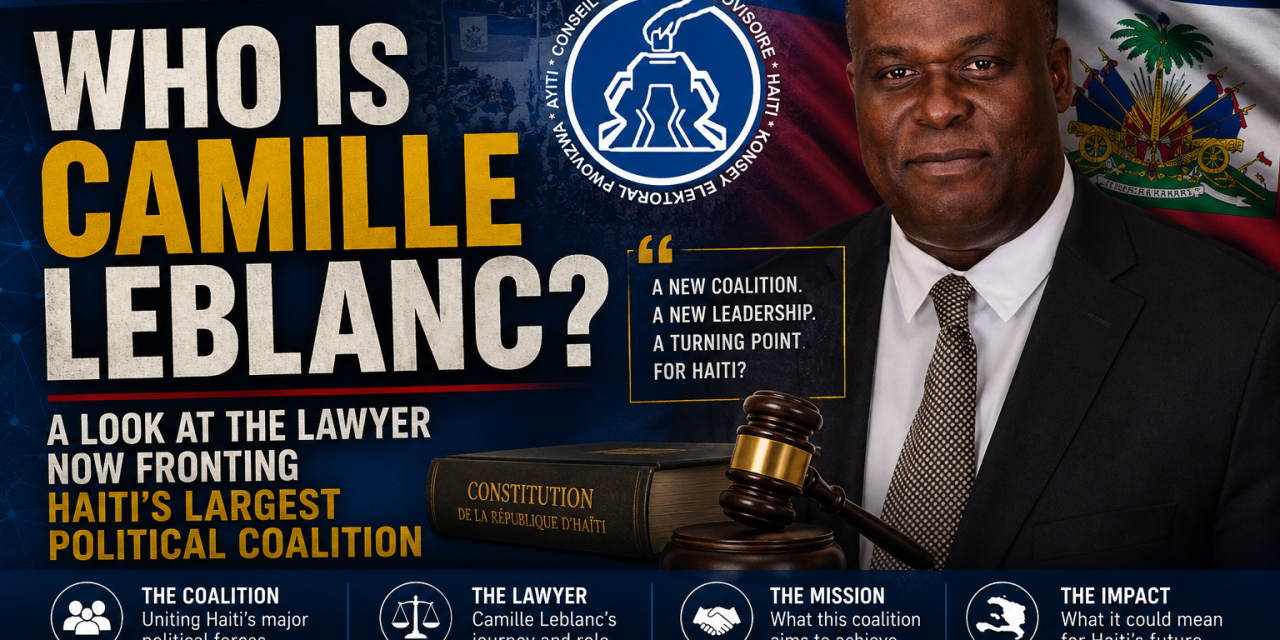
As Haiti’s Provisional Electoral Council (CEP) finalized its list of approved political groupements for the country’s upcoming elections, one name stood out for the sheer size of the coalition behind it: VIKTWA, led by attorney Camille Leblanc, was confirmed on August 8, 2026 as the largest of the 15 approved groupements — bringing together as many as 52 political parties under one banner, according to the CEP’s own published list. That makes Leblanc, at least on paper, the single most consequential coalition-builder in Haiti’s current electoral landscape. So who is he, and what does his record actually show?
A Career Rooted in the Justice System
According to his professional record, Leblanc has spent nearly four decades as a practicing attorney, running Cabinet Leblanc as Senior Lawyer since January 1988 — a legal career that predates most of the political turbulence Haiti has lived through since. But his most consequential chapter in public life came in the late 1990s, when he moved from private practice into the heart of Haiti’s security and justice institutions:
- January–November 1995: Special Legal Advisor (Conseiller juridique spécial) at the Ministry of Justice and Security.
- January 1995–March 1999: Director of Legal Affairs (Directeur affaires juridiques) at the Police Nationale d’Haïti — a four-year-plus posting inside the national police’s legal apparatus during a formative, difficult period for that institution.
- March 1999–March 2001: Minister of Justice and Public Security (Ministre de la Justice et de la Sécurité Publique).
That last appointment places him squarely inside one of the more turbulent stretches of René Préval’s first presidency. Préval had dissolved most of Haiti’s legislature in January 1999 amid a prolonged political stalemate, governing largely by decree for over a year. It was in that climate — on March 26, 1999 — that Préval named Jacques-Édouard Alexis as Prime Minister to finally end a long government vacancy. Leblanc’s appointment as Justice Minister falls in that same window, meaning he entered one of the country’s top security posts as part of a government stood up specifically to break a constitutional crisis, rather than through an ordinary electoral transition.
An Institutional Career Stretching Back to 1989
His 1999 cabinet appointment, it turns out, was not his entry point into Haitian government — it was closer to the midpoint of a career already a decade deep in state institutions. Records show his public service began at the tail end of the post-Duvalier transitional period:
- March 1989–June 1991: Simultaneously served as Legal Advisor (Conseiller Juridique) at the Office de la Protection du Citoyen — Haiti’s ombudsman institution, created under the 1987 Constitution — and as a member of the cabinet of the Minister of Justice (Membre du Cabinet du Ministre de la Justice). This period covers the fragile transitional governments that preceded Jean-Bertrand Aristide’s first inauguration in February 1991.
- November 1994–November 1995: Member of the cabinet of the Minister of Women’s Condition (Ministre de la Condition Féminine), overlapping with his subsequent role as Special Legal Advisor at the Ministry of Justice and Security from January to November 1995.
Taken together with his later Police Nationale and Justice Ministry roles, Leblanc’s documented government service now spans, in some form, from 1989 through 2001 — covering the transitional governments after the Duvalier dictatorship, Aristide’s first term and its interruption, and Préval’s first presidency — before his post-2001 pivot into party politics with ADHEBA and, now, VIKTWA.
From Cabinet Minister to Party Founder
After leaving government in 2001, Leblanc’s political path continued through party-building rather than a return to elected office. Public records show he founded Action Démocratique pour Bâtir Haïti (ADHEBA) in 2004, which he has led as president. The party’s electoral track record has been modest: ADHEBA won just 1 of 99 seats in the Chamber of Deputies in the 2006 legislative elections — a result that shows the party achieved formal standing in Haitian politics without translating into significant legislative weight.
In the years since, Leblanc’s public political activity has centered on coalition and platform-building rather than running for office himself. He’s been named in connection with AIMER-HAÏTI, a socio-political organization referenced in a 2022 joint statement from a coalition of Haitian political and civil society figures responding to the country’s post-assassination crisis. More recently, and most significantly, he registered and now represents VIKTWA — the political groupement that Haitian outlet HPN Info has described as aligned with “le pouvoir en place” (the current government in power), registered with the CEP ahead of the 2026 elections.
The Numbers Behind VIKTWA
The scale of VIKTWA is genuinely notable. Of the 18 political groupements that filed for CEP approval, only 15 were approved outright by the August 8 deadline, and VIKTWA’s roster dwarfs the others — some outlets report the CEP’s own documentation shows inconsistency between a “50 parties” header and an actual list running to 52 organizations. By comparison, the next-largest approved groupements — SOLÈY and Ayiti Transfòme — represent 13 and 12 parties respectively. In sheer coalition-building terms, no one else in this electoral cycle has assembled a comparable number of parties under a single umbrella.
What This Record Does — and Doesn’t — Show
Leblanc’s documented history shows a figure who has remained continuously embedded in Haiti’s institutional and political apparatus for close to four decades: from a legal advisory post at the citizen ombudsman’s office during the fragile post-Duvalier transition, through cabinet roles spanning the Justice and Women’s Condition ministries, to the police’s legal directorate, to a cabinet post during a government-by-decree crisis, to founding his own party, to now fronting the largest political coalition heading into 2026. That’s a real, verifiable pattern of institutional longevity — one that predates most of the political figures currently active in Haitian politics.
Whether that amounts to a lack of new ideas, as some critics might argue, or instead reflects deep institutional knowledge and coalition-building skill that few others in Haitian politics can match, isn’t something the public record alone settles. What the record does show clearly: ADHEBA’s limited electoral success in 2006 suggests his own party never built substantial independent voter support, and VIKTWA’s reported alignment with current power structures raises a legitimate question worth watching — whether the coalition represents a genuine broadening of Haiti’s political conversation, or a consolidation of already-established political actors under new branding. Voters and observers will have grounds to judge that for themselves as the 2026 electoral process moves forward.
This article is based on publicly available professional records and Haitian press coverage of the 2026 electoral process. It is intended for informational purposes only