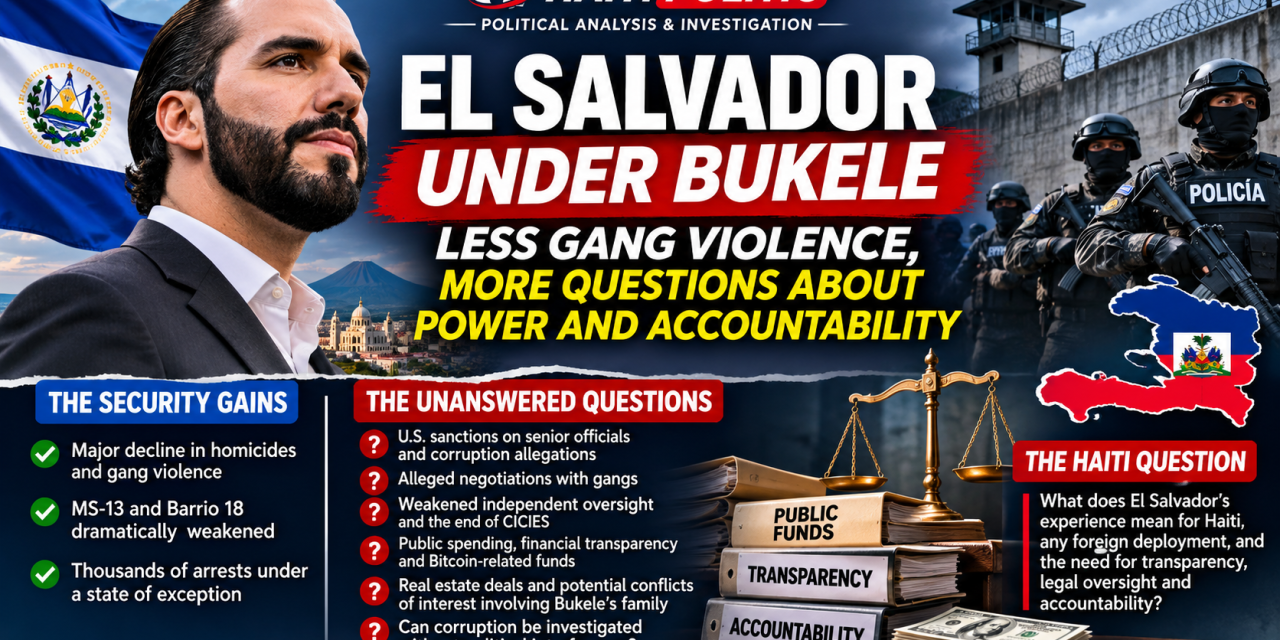
Inside the decline of MS-13 and Barrio 18, U.S. sanctions against senior officials, allegations of secret gang negotiations, financial secrecy, and the questions surrounding El Salvador’s military involvement in Haiti.
HAITI POLITIC | SPECIAL INVESTIGATION & POLITICAL ANALYSIS
November 21, 2026
INTRODUCTION: THE SECURITY SUCCESS STORY AND THE QUESTIONS BEHIND IT
President Nayib Bukele has transformed El Salvador’s international reputation.
Once associated with extraordinary levels of gang violence, extortion, and homicide, the Central American country is now frequently presented by its government as an example of what aggressive security policies can accomplish.
Bukele’s supporters point to declining homicide rates, the weakening of MS-13 and Barrio 18, and the restoration of public access to neighborhoods previously dominated by criminal organizations.
Those developments are significant.
However, the security narrative is only one part of the story.
Behind El Salvador’s declining homicide figures are serious questions involving alleged government corruption, secret negotiations with criminal organizations, mass incarceration, restrictions on public information, and the independence of institutions responsible for investigating powerful officials.
These questions have become particularly relevant as Bukele expands his international security profile, including through Salvadoran participation in security operations in Haiti.
Can a government demonstrate measurable success against organized crime while simultaneously weakening the institutions responsible for preventing corruption and abuse of power?
And what should Haiti learn from El Salvador’s experience before accepting foreign security assistance?
These are the questions at the center of this Haiti Politic investigation.
1. EL SALVADOR’S DECLINING HOMICIDE RATE: WHAT THE NUMBERS SHOW
El Salvador experienced exceptionally high levels of criminal violence long before Bukele assumed the presidency in June 2019.
For years, MS-13 and Barrio 18 exercised territorial control over communities, extorted businesses, recruited young people, and threatened residents.
Official Salvadoran statistics show a substantial decline in homicides.
| Year | Officially reported homicides |
|---|---|
| 2017 | 3,962 |
| 2018 | 3,346 |
| 2019 | 2,398 |
| 2020 | 1,341 |
| 2021 | 1,147 |
| 2022 | 495 |
| 2023 | 154 |
| 2024 | 114 |
| 2025 | 82 |
These figures indicate a dramatic reduction in recorded lethal violence.
For many Salvadorans who previously experienced gang intimidation, extortion, and restrictions on their movement, improved neighborhood security has had practical consequences.
Businesses can operate in areas where criminal organizations previously demanded payments. Families have reported greater freedom of movement, and some communities have experienced a reduction in visible gang activity.
However, official homicide statistics have limitations.
Independent researchers have questioned the government’s classification of certain deaths, including fatalities involving security forces and deaths occurring in detention.
Furthermore, a reduction in homicide does not automatically establish that other forms of insecurity have disappeared.
Homicide rates measure one important dimension of public safety. They do not independently measure corruption, arbitrary detention, judicial independence, or government accountability.
This distinction is essential when evaluating Bukele’s security model.
2. THE STATE OF EXCEPTION: HOW BUKELE CONFRONTED THE GANGS
In March 2022, following a deadly surge in gang-related killings, Bukele’s government introduced a nationwide state of exception.
The emergency regime expanded the powers of security forces and restricted certain constitutional protections.
Authorities launched large-scale operations targeting suspected members of MS-13 and Barrio 18.
Tens of thousands of people were arrested.
By 2026, the number of detentions under the emergency measures had exceeded 90,000, according to government figures.
The government argues that these operations were necessary to dismantle criminal organizations that had exercised influence over Salvadoran society for decades.
Independent organized-crime researchers have acknowledged that the crackdown substantially weakened the country’s major gangs.
Yet the methods have generated controversy.
Human rights organizations have documented allegations involving arbitrary arrests, insufficient evidence, restricted access to legal counsel, and mistreatment in detention.
The government maintains that its policies have restored security and that extraordinary measures were justified by the threat posed by organized crime.
The central question is whether El Salvador can maintain its security gains while restoring ordinary legal protections.
A sustainable security system requires more than the ability to arrest suspected criminals. It also requires courts capable of distinguishing guilt from innocence.
3. U.S. SANCTIONS AGAINST SENIOR BUKELE OFFICIALS
One of the most significant controversies surrounding Bukele’s administration concerns allegations involving senior government officials.
In December 2021, the United States Treasury Department imposed sanctions on several Salvadoran officials.
Among those sanctioned were:
Osiris Luna Meza, a senior official responsible for El Salvador’s prison system.
Carlos Amílcar Marroquín Chica, a government official involved in community-development programs.
U.S. authorities accused these officials of participating in secret negotiations with MS-13 and Barrio 18.
According to the Treasury Department, the alleged arrangements involved benefits for imprisoned gang leaders and understandings intended to reduce homicide levels and generate political support.
The United States also sanctioned Martha Carolina Recinos, Bukele’s chief of staff, over allegations involving misuse of public funds during the COVID-19 pandemic.
These were formal sanctions issued by the U.S. government.
However, sanctions are not equivalent to criminal convictions.
They establish that U.S. authorities made specific findings sufficient for sanctions under American law, not that Salvadoran courts convicted the individuals of the alleged offenses.
The allegations nevertheless raise a fundamental question.
How could officials responsible for combating criminal organizations also face accusations of negotiating political arrangements with those organizations?
This question deserves examination independently of the government’s subsequent success in reducing violence.
4. THE ALLEGED SECRET NEGOTIATIONS WITH MS-13
The controversy surrounding alleged negotiations between Salvadoran officials and gang leaders extends beyond the U.S. sanctions.
Investigative journalists have examined allegations that representatives of Bukele’s administration communicated with imprisoned gang leaders before the 2022 security crackdown.
The reported negotiations allegedly involved prison conditions, political support, and reductions in violence.
In June 2025, ProPublica published an investigation examining a U.S. law-enforcement inquiry into suspected connections between senior Salvadoran officials and MS-13.
The reporting described allegations involving potential financial misconduct and the handling of investigative evidence.
It also examined whether American investigators had considered reviewing financial accounts connected to individuals close to the president.
Importantly, these allegations do not establish that Bukele personally participated in financial crimes or that any particular allegation was proven in court.
The Salvadoran government has disputed allegations of improper agreements with gangs.
Nevertheless, the controversy creates an important distinction between two questions.
The first is whether the government successfully weakened criminal organizations after March 2022.
The second is whether officials engaged in improper negotiations with those organizations before the crackdown.
Evidence of success in reducing violence does not automatically resolve allegations of earlier government misconduct.
Both issues require independent examination.
5. WHAT HAPPENED TO EL SALVADOR’S ANTICORRUPTION COMMISSION?
In 2019, El Salvador established cooperation with the Organization of American States through the International Commission against Impunity in El Salvador, commonly known as CICIES.
The commission was intended to support investigations into corruption and strengthen institutional accountability.
However, the Salvadoran government ended the arrangement in 2021.
The decision occurred during a period of growing controversy surrounding investigations into government officials and the independence of judicial institutions.
Bukele’s legislative allies also replaced the attorney general and judges of the Supreme Court’s Constitutional Chamber in May 2021.
Supporters of the government defended these changes as necessary institutional reforms.
Critics argued that they weakened the separation of powers and reduced independent oversight of the executive branch.
Human Rights Watch subsequently documented concerns about the dismantling of prosecutorial structures that had investigated alleged corruption and gang negotiations.
This raises a question extending beyond any single administration.
Can a government credibly investigate corruption involving its own senior officials when the institutions responsible for those investigations lack sufficient independence?
Anticorruption enforcement requires prosecutors, judges, auditors, and oversight institutions capable of investigating powerful individuals without political interference.
6. PUBLIC MONEY, GOVERNMENT CONTRACTS, AND FINANCIAL SECRECY
Another area of concern involves public access to government financial information.
Freedom House and other organizations have documented restrictions affecting transparency and access to public records under Bukele’s administration.
Critics have raised concerns about government procurement, confidential financial information, and the availability of public officials’ asset declarations.
These restrictions can make it difficult for journalists and citizens to determine how public money is being spent.
The concerns became particularly relevant during the COVID-19 pandemic, when governments around the world made emergency purchases under accelerated procurement procedures.
In El Salvador, allegations concerning pandemic-related expenditures contributed to investigations and sanctions involving government officials.
Financial transparency also became an issue surrounding the government’s adoption of Bitcoin.
Bukele promoted Bitcoin as part of an ambitious economic modernization strategy.
However, critics questioned the use of public resources, the management of government-backed digital infrastructure, and the disclosure of financial risks.
Under El Salvador’s IMF-supported economic program, authorities subsequently committed to greater financial transparency.
In October 2026, the IMF reported the publication of special audits concerning Bitcoin-related public funds and financial statements associated with the Chivo digital wallet.
Those disclosures represent an important development.
However, an audit’s publication is only one component of accountability.
The public must also be able to examine its findings, identify irregularities, and determine whether corrective action was taken.
Transparency means more than publishing financial documents. It means allowing independent institutions to verify how public resources were used.
7. BUKELE’S FAMILY, REAL ESTATE, AND POTENTIAL CONFLICTS OF INTEREST
Investigative reporting has also examined property acquisitions involving Bukele and members of his family.
Human Rights Watch summarized reporting indicating that Bukele and relatives acquired approximately 363 hectares of land during his first presidential term.
Additional reporting examined a property purchase involving Karim Bukele, the president’s brother and adviser.
The transaction attracted scrutiny because it occurred in a context involving government policies that offered tax incentives for certain investments.
These reports raise questions about financial disclosure, beneficial ownership, and potential conflicts of interest.
However, purchasing real estate is not inherently unlawful.
Nor does a family relationship with a public official establish corruption.
A finding of misconduct would require evidence demonstrating improper preferential treatment, unlawful enrichment, misuse of public resources, or another violation of applicable law.
The relevant public-interest questions are therefore specific.
Were the transactions properly disclosed?
Were government incentives available equally to qualifying investors?
Did any public official participate in decisions that directly benefited a private financial interest?
Were independent authorities able to investigate potential conflicts?
Public officials and their relatives should be subject to transparent conflict-of-interest rules, regardless of their political affiliation.
8. WHAT TRANSPARENCY INTERNATIONAL’S CORRUPTION INDEX REVEALS
Transparency International’s Corruption Perceptions Index provides another perspective on El Salvador’s governance.
The index measures perceived public-sector corruption using assessments from experts and business sources.
A score of 100 represents the lowest perceived corruption, while a score of zero represents the highest.
El Salvador received the following scores:
| Year | Corruption Perceptions Index |
|---|---|
| 2020 | 36/100 |
| 2023 | 31/100 |
| 2024 | 30/100 |
| 2025 | 32/100 |
The figures show that El Salvador’s 2025 score remained below its 2020 level, although it improved slightly compared with 2024.
These results do not establish that Bukele personally committed corruption.
They also do not measure the amount of public money stolen.
Instead, they provide an indication of how public-sector corruption is perceived by the experts and institutions contributing to the index.
The contrast with homicide statistics is notable.
El Salvador’s official homicide figures declined substantially during a period when its corruption-perception scores remained relatively low.
The two measurements assess different dimensions of government performance. Improvement in one does not automatically imply improvement in the other.
9. HAS BUKELE’S GOVERNMENT PROSECUTED CORRUPTION?
An examination of corruption under Bukele must also acknowledge the government’s anticorruption prosecutions.
Salvadoran authorities have pursued investigations involving officials from previous administrations, municipal governments, and Bukele’s own Nuevas Ideas party.
The U.S. State Department’s 2023 human rights report documented several such cases.
The existence of these investigations is relevant evidence that the government has undertaken anticorruption enforcement.
However, critics have questioned whether enforcement has been politically selective.
A credible assessment requires examining which cases were investigated, whether evidence supported prosecution, and whether defendants received fair judicial proceedings.
The most demanding test of institutional independence is not whether a government prosecutes its political opponents.
It is whether investigators can examine allegations involving the president’s closest associates without interference.
10. THE CONNECTION TO HAITI: SECURITY COOPERATION AND PUBLIC ACCOUNTABILITY
El Salvador’s domestic governance record has become increasingly relevant to Haiti because of Salvadoran participation in international security operations.
Haiti faces an extraordinary security crisis involving armed groups, displaced communities, weakened institutions, and the loss of effective state control in numerous areas.
Foreign security assistance may contribute to efforts to restore public safety.
However, the legal and financial arrangements governing such assistance deserve public scrutiny.
Several questions remain essential.
Who authorized the deployment of Salvadoran personnel?
Under what international or bilateral legal framework are they operating?
Who pays their salaries, transportation, equipment, medical expenses, and insurance?
What operational powers have they been granted?
Who investigates allegations of misconduct?
What mechanisms ensure that public funds are properly managed?
And what conditions will determine when the deployment ends?
These questions are particularly important because Haiti is governed by transitional authorities without a functioning elected Parliament.
The absence of ordinary legislative oversight creates additional challenges for public accountability.
However, it is important to distinguish between Salvadoran participation in an internationally authorized security mission and a separate bilateral military agreement.
The existence and terms of a separate Fils-Aimé–Bukele bilateral military agreement have not been independently established in the information examined for this article.
Consequently, it would be premature to declare such an agreement unconstitutional without examining the relevant documents and legal authorities.
Nevertheless, Haiti’s constitutional framework and the principles of national sovereignty require careful examination of any arrangement granting foreign forces operational authority on Haitian territory.
11. THE REPORTED SALVADORAN MILITARY CASUALTIES IN HAITI
Recent social-media material attributed to the Salvadoran armed forces reported an explosion involving four Salvadoran personnel in Haiti.
According to the circulating statement, two personnel died and two others were injured while working with explosives at a military camp.
These reports require independent confirmation, including verification of the statement’s authenticity and the circumstances of the incident.
If confirmed, the deaths would raise serious questions about operational safety, military command, and the government’s responsibility toward deployed personnel.
They would also underline the importance of establishing clear objectives and safety procedures before committing soldiers to hazardous foreign operations.
A president’s responsibility as commander-in-chief includes explaining the mission, supporting affected families, and ensuring that fatal incidents receive appropriate investigation.
Public recognition of military operations should be accompanied by transparency when casualties occur.
However, the absence of a condolence message from a particular social-media account does not establish that the president or his government failed to communicate condolences through other channels.
The appropriate question is what official acknowledgment, investigation, and support have been provided to the affected personnel and their families.
12. WHY EL SALVADOR’S SECURITY MODEL CANNOT SIMPLY BE TRANSPLANTED TO HAITI
El Salvador and Haiti have different histories, institutions, and security environments.
El Salvador’s major gangs developed through particular patterns of criminal organization, territorial influence, prison networks, and extortion.
Haiti’s security crisis involves multiple armed organizations operating amid institutional fragmentation, political instability, and serious weaknesses in the justice system.
The challenges facing the Haitian National Police also differ from those facing Salvadoran security institutions.
Consequently, the effectiveness of a security strategy in El Salvador does not establish that the same approach will produce comparable results in Haiti.
A sustainable Haitian security strategy would require strengthening the Haitian National Police, restoring judicial capacity, protecting property rights, and rebuilding government authority.
It would also require ensuring that displaced families can return safely to their homes and recover access to their property.
Foreign military assistance may address certain immediate security needs.
But lasting public safety depends on functioning Haitian institutions.
The objective should be to strengthen Haiti’s capacity to govern and protect its own territory rather than create indefinite dependence on foreign security forces.
13. TEN QUESTIONS PRESIDENT BUKELE SHOULD ANSWER
The following questions concern El Salvador’s domestic governance and its international security commitments.
1. What is the current status of investigations involving senior officials sanctioned by the United States?
Have Salvadoran prosecutors independently examined the allegations?
2. What happened to investigations into alleged negotiations between government representatives and MS-13?
Were the relevant records preserved and independently reviewed?
3. Why did El Salvador terminate its cooperation with CICIES?
What independent institution replaced its anticorruption functions?
4. Will the administration publish comprehensive financial disclosures for senior officials?
What safeguards prevent conflicts of interest?
5. What do the government’s Bitcoin-related audits establish?
Have all relevant public expenditures been independently examined?
6. Can El Salvador maintain low homicide rates without indefinitely extending emergency powers?
What is the government’s long-term strategy for restoring ordinary constitutional protections?
7. How many people detained under the state of exception have received individualized judicial proceedings?
What remedies exist for wrongful detention?
8. What independent mechanisms investigate alleged deaths and mistreatment in custody?
Are their findings publicly accessible?
9. What is the complete legal and financial framework governing Salvadoran security personnel deployed in Haiti?
Who authorized the operation, and who finances it?
10. What measures protect Salvadoran personnel serving abroad?
What procedures govern the investigation of serious injuries or fatalities?
These questions concern matters of public accountability rather than assumptions of personal criminal guilt.
CONCLUSION: SECURITY, CORRUPTION, AND THE LIMITS OF PRESIDENTIAL POWER
El Salvador’s experience under Nayib Bukele demonstrates that a government can achieve a substantial reduction in recorded criminal violence while facing serious questions about institutional accountability.
The weakening of MS-13 and Barrio 18 is an important security development.
At the same time, U.S. sanctions against senior officials, allegations of secret gang negotiations, restrictions on public information, and concerns about judicial independence warrant continued scrutiny.
Neither side of this record should be ignored.
Declining homicide rates do not prove that corruption has disappeared.
Likewise, allegations of corruption do not erase measurable improvements in public safety.
A complete assessment requires examining both developments independently.
For Haiti, the lesson is particularly important.
Security cooperation should be governed by transparent agreements, clearly defined responsibilities, financial accountability, and respect for national sovereignty.
The Haitian public should be able to examine the legal authority and operational objectives of any foreign security deployment.
And the Salvadoran public should be able to determine how its government uses public resources and protects military personnel serving abroad.
The central question is not whether President Bukele has reduced gang violence. Official statistics show a substantial reduction.
The broader question is whether El Salvador can preserve those security gains while ensuring that its institutions remain capable of investigating corruption, protecting individual rights, and holding powerful officials accountable.
For Haiti, the parallel question is whether foreign security assistance will contribute to rebuilding accountable Haitian institutions or create new dependencies without resolving the underlying institutional crisis.
Security, constitutional safeguards, and public accountability are not mutually exclusive objectives. A durable security policy must address all three.
SOURCES AND FURTHER READING
U.S. Department of the Treasury: December 2021 sanctions concerning Salvadoran government officials and alleged negotiations with criminal gangs.
ProPublica: June 2025 investigation into U.S. law-enforcement inquiries concerning alleged connections between Salvadoran officials and MS-13.
Human Rights Watch: World Reports 2025 and 2026, El Salvador chapters.
U.S. Department of State: 2023 Country Reports on Human Rights Practices — El Salvador.
Transparency International: Corruption Perceptions Index, El Salvador country data.
International Monetary Fund: El Salvador economic-program documentation and October 2026 reporting concerning financial transparency and Bitcoin-related audits.
Freedom House: Freedom in the World 2025 — El Salvador.
Organization of American States / Inter-American Commission on Human Rights: Reports and statements concerning emergency powers, detention practices, and human rights protections in El Salvador.
Editorial disclosure: This article distinguishes official statistics, documented sanctions, investigative allegations, and political analysis. The reported November 2026 Salvadoran military casualties in Haiti and the existence of a separate bilateral military agreement require further independent verification.
© 2026 HAITI POLITIC | SPECIAL INVESTIGATION & POLITICAL ANALYSIS