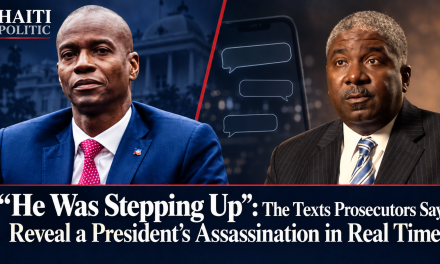
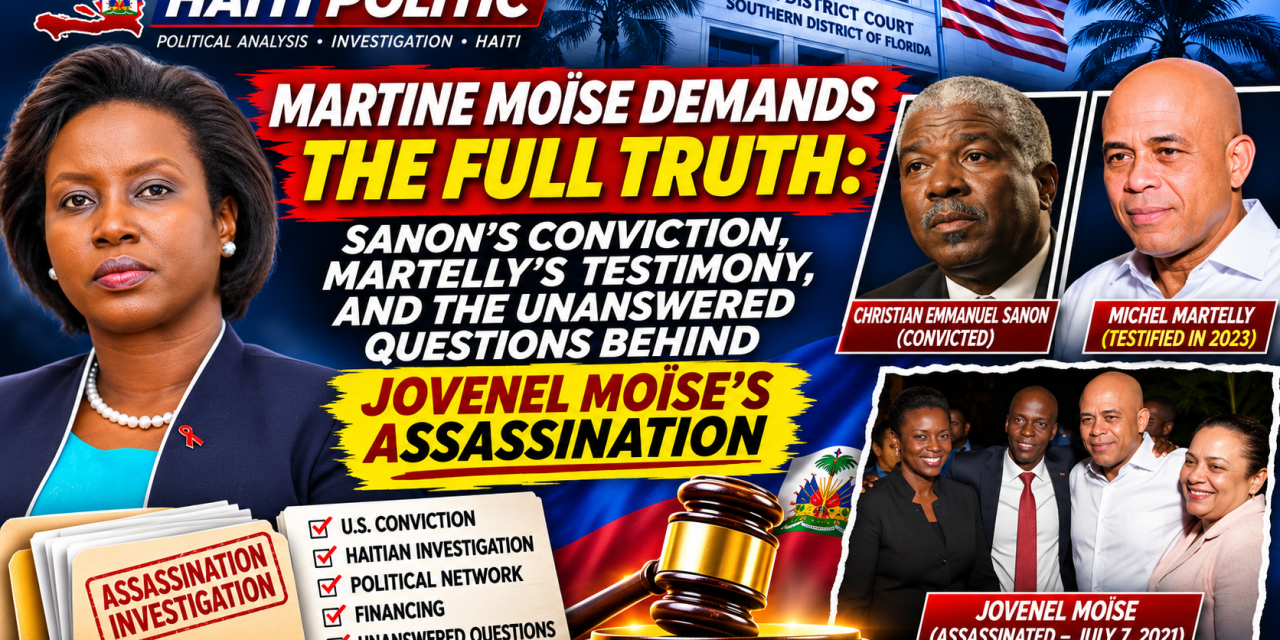
Following Christian Emmanuel Sanon’s conviction in Miami, Martine Moïse calls for the identification of everyone who planned, ordered, and financed her husband’s assassination. Meanwhile, Michel Martelly’s October 2023 appearance before a Haitian investigating judge raises renewed questions about what Haiti’s political establishment knows about the conspiracy.
HAITI POLITIC | POLITICAL & LEGAL ANALYSIS
November 21, 2026
INTRODUCTION: TWO STATEMENTS, ONE ASSASSINATION, AND FIVE YEARS OF UNANSWERED QUESTIONS
On November 21, 2026, former Haitian First Lady Martine Moïse publicly thanked the United States Department of Justice following the conviction of Christian Emmanuel Sanon in connection with the assassination of President Jovenel Moïse.
Her statement was emotional, but its political significance extended beyond gratitude.
Martine Moïse emphasized that the struggle for justice must continue until everyone responsible for planning, ordering, and financing the assassination is identified.
Her message came three days after a federal jury in Miami convicted Sanon on eight criminal charges connected to the July 7, 2021, assassination.
The verdict represents another major development in one of Haiti’s most consequential criminal investigations.
Yet it also revives questions about the political figures, business interests, and financial arrangements surrounding the conspiracy.
Among the historical statements deserving renewed examination is an October 3, 2023, declaration by former Haitian President Michel Martelly.
That day, Martelly publicly confirmed that he had appeared before investigating judge Walther Wesser Voltaire in connection with the assassination investigation.
The two statements, published more than three years apart, offer different perspectives on the same unresolved national tragedy.
Martine Moïse demands the identification of the entire network responsible.
Michel Martelly emphasized his cooperation with Haitian judicial authorities.
Neither statement establishes Martelly’s involvement in the assassination.
However, the contrast raises a legitimate question:
After five years of investigations, convictions, and political upheaval, how much does Haiti actually know about the individuals who expected to benefit from President Jovenel Moïse’s removal?
1. CHRISTIAN EMMANUEL SANON CONVICTED IN MIAMI
On November 18, 2026, a federal jury in Miami found Christian Emmanuel Sanon guilty on eight charges connected to the conspiracy that resulted in President Jovenel Moïse’s assassination.
The verdict followed a trial lasting nearly eight weeks.
According to the U.S. Department of Justice, the charges included conspiracy to provide material support resulting in death, providing material support resulting in death, conspiracy to kill or kidnap a person outside the United States, and additional offenses involving the United States.
Sanon faces a possible life sentence.
His sentencing is scheduled for February 10, 2027.
His defense attorney has indicated that the defense intends to appeal.
The conviction is therefore a jury verdict, not yet a final resolution of every potential appellate issue.
Nevertheless, the verdict represents a substantial development in the federal investigation.
The Justice Department described Sanon as a participant in a conspiracy intended to overthrow Haiti’s elected president and install a replacement government.
According to prosecutors, Sanon initially expected to become Haiti’s next president.
When that plan failed, prosecutors said he continued participating in the conspiracy in a different capacity.
The government presented evidence involving logistical arrangements, financial commitments, communications, and preparations for the operation.
The conviction is particularly important because it addresses the political objectives behind the assassination, not simply the physical attack.
The conspiracy was not limited to killing a president. According to the prosecution’s evidence, it also involved plans to establish a replacement government and distribute valuable contracts.
That distinction is essential to understanding why the investigation continues to carry political significance.
2. MARTINE MOÏSE: THE CONVICTION IS A BEGINNING, NOT THE END
In her November 21 statement, Martine Moïse expressed gratitude to the American justice system.
She thanked federal prosecutors, investigators, translators, jurors, and others who contributed to the proceedings.
She also acknowledged journalists who followed the trial and reported information presented in federal court.
But the most significant portion of her statement concerned what remains unresolved.
Martine Moïse insisted that the investigation must continue until everyone who planned, ordered, and financed the assassination is identified.
Her statement reflects a distinction between two forms of accountability.
The first involves prosecuting individuals who participated directly in the criminal conspiracy.
The second involves establishing the complete political, organizational, and financial network behind the operation.
Sanon’s conviction contributes to the first objective and provides evidence relevant to the second.
However, it does not necessarily establish the identity or responsibility of every person who may have participated in the broader conspiracy.
Martine Moïse also thanked President Donald Trump’s administration for declassifying documents that she believes could help clarify the circumstances surrounding her husband’s assassination.
Her statement did not identify every document involved or explain precisely what those records establish.
Consequently, any conclusions about their contents must await examination of the actual records.
The central message of Martine Moïse’s statement is that justice should not end with the people already convicted.
It must continue wherever reliable evidence leads.
3. MICHEL MARTELLY’S OCTOBER 3, 2023, STATEMENT RETURNS TO THE SPOTLIGHT
On October 3, 2023, former President Michel Martelly appeared before Haitian investigating judge Walther Wesser Voltaire.
The appearance concerned the judicial investigation into President Jovenel Moïse’s assassination.
Martelly subsequently published a statement on his social-media account confirming his participation.
He explained that he had appeared before the judge out of respect for Haitian law and judicial authorities.
He also stated that he would respect the confidentiality of the investigation and assist the justice system in identifying those responsible.
The appearance was independently reported at the time.
According to the Spanish news agency EFE, Martelly was questioned for approximately four hours.
This establishes an important fact.
Michel Martelly was among the political figures questioned during Haiti’s investigation into Jovenel Moïse’s assassination.
However, a judicial appearance does not establish criminal responsibility.
A former president may be questioned because investigators believe he possesses relevant information.
Being questioned is not equivalent to being charged.
Nor is participation in an investigation evidence that the person committed the crime under examination.
The publicly available information examined for this article does not establish that Martelly was convicted of participating in the assassination.
Nevertheless, the circumstances surrounding his appearance deserve documentary examination.
What questions did Judge Voltaire ask?
What information did Martelly provide?
Did investigators examine political relationships, financial transactions, or communications involving individuals connected to the conspiracy?
Were any of those subjects subsequently addressed in the American proceedings?
Without the complete judicial record, those questions remain unanswered.
4. MARTINE MOÏSE AND MICHEL MARTELLY: TWO DIFFERENT PUBLIC POSITIONS
The contrast between Martine Moïse’s latest statement and Martelly’s earlier declaration is politically significant.
Martine Moïse is demanding that the investigation identify the complete network responsible for her husband’s assassination.
Martelly’s statement emphasized his willingness to cooperate with judicial authorities.
The distinction does not automatically place the two individuals in opposition.
Both publicly expressed support for the judicial process.
However, their statements reflect different relationships to the investigation.
Martine Moïse survived the attack in which her husband was killed.
Her demand for accountability concerns the full circumstances of the crime.
Martelly is a former president who was questioned as part of the Haitian investigation.
His public statement concerns his participation in that inquiry.
The appropriate journalistic question is not whether one statement proves the other person is guilty.
It is whether the investigations in Haiti and the United States have produced a sufficiently complete account of the conspiracy.
Political accountability requires more than public declarations of cooperation. It requires institutions capable of examining evidence and explaining their findings.
That principle applies to every person questioned, regardless of political affiliation or previous office.
5. THE ASSASSINATION CONSPIRACY WAS ALSO A POLITICAL PROJECT
The evidence presented in Miami reveals that the conspiracy involved plans extending beyond the physical attack against President Moïse.
According to the Justice Department, Sanon and his associates initially pursued a plan to remove the president and install Sanon as Haiti’s new leader.
Prosecutors said Sanon falsely claimed to have support from the U.S. Department of State.
The purpose of those claims, according to the government, was to recruit allies and create an appearance of political legitimacy.
The conspirators also anticipated establishing a replacement government.
The Justice Department identified several individuals involved in the conspiracy, including Arcangel Pretel Ortiz, Antonio Intriago, Walter Veintemilla, and James Solages.
In May 2026, a federal jury convicted those four defendants of offenses connected to the assassination plot.
Sanon’s conviction followed in November.
The prosecution’s account also described the recruitment of Colombian military veterans and the acquisition of equipment used in the operation.
These developments raise an important political question.
Who expected to govern Haiti after Jovenel Moïse was removed from power?
According to federal prosecutors, Sanon was initially the preferred candidate.
However, investigators said the conspirators eventually concluded that he lacked the constitutional qualifications and political support necessary to assume the presidency.
Their attention subsequently shifted toward former Haitian Supreme Court judge Wendelle Coq Thélot.
Coq Thélot died in January 2025 while a fugitive.
The shift demonstrates that the conspirators’ political objectives evolved during the planning process.
It also reinforces the importance of examining the relationships among political actors, financiers, and operational organizers.
6. THE BUSINESS CONNECTION: GOVERNMENT CONTRACTS AND FINANCIAL INCENTIVES
One of the most consequential elements of the federal case concerns anticipated government contracts.
According to prosecutors, Sanon promised valuable future contracts in exchange for financial, logistical, and operational support.
The arrangements involved Florida-based businesses associated with the Counter Terrorist Unit, commonly identified as CTU.
The anticipated contracts reportedly covered infrastructure development, security services, and military equipment.
This introduces an important economic dimension to the assassination conspiracy.
The alleged financial incentive was not simply an immediate payment for services.
It included the expectation that a new Haitian government would award lucrative contracts after taking power.
The structure raises questions about how private business interests became connected to a violent attempt to replace an elected president.
Who negotiated the anticipated contracts?
What financial commitments were made?
Which companies expected to benefit?
Were additional Haitian business or political figures approached?
Did any prospective contracts depend on control over specific government institutions?
These questions require documentary answers.
The existence of anticipated contracts does not establish that every person who might have benefited knew about the assassination plan.
However, the prosecution’s evidence demonstrates why financial records are essential to reconstructing the conspiracy.
Following the money may be as important as identifying the individuals who carried out the attack.
7. THE COVID-19 RELIEF MONEY CONNECTION
Another significant development involves allegations concerning the financing of the conspiracy.
Federal investigators have examined whether funds obtained through American pandemic-relief programs were used to support the operation.
The Justice Department reported that additional defendants were indicted in September 2026 in connection with the assassination conspiracy.
The charges included allegations involving fraud and money laundering related to funds obtained through the Paycheck Protection Program.
That federal program was intended to help businesses maintain operations during the COVID-19 pandemic.
According to prosecutors, money associated with alleged fraud involving the program helped finance the assassination plot.
These allegations introduce another layer of financial accountability.
If public relief funds intended to support American businesses were diverted into a conspiracy against Haiti’s president, investigators must establish the complete financial trail.
Which businesses received the funds?
Who controlled the accounts?
How were the proceeds transferred?
Which expenditures supported the operation?
And who knew the ultimate purpose of the transactions?
The indictment of additional defendants does not establish their guilt.
Those allegations must be proven through the judicial process.
Nevertheless, the financial investigation demonstrates that the assassination case extends across international borders and multiple financial systems.
8. WHY THE HAITIAN INVESTIGATION REMAINS ESSENTIAL
The American proceedings have produced convictions and substantial evidence concerning the conspiracy.
However, the assassination occurred in Haiti.
The crime involved the killing of Haiti’s elected president at his private residence.
Its consequences directly affected Haiti’s constitutional order and political institutions.
Consequently, the Haitian investigation remains essential even as American courts continue prosecuting defendants.
Haitian judicial authorities have examined witnesses, political figures, security personnel, and other individuals believed to possess relevant information.
The investigation has also faced significant institutional challenges.
Haiti’s justice system has operated amid political instability, insecurity, and the absence of a functioning elected national government.
Those conditions make it difficult to conduct complex criminal investigations.
They also increase the importance of preserving evidence and protecting witnesses.
The Haitian public deserves to know whether the country’s judicial authorities can establish an independent account of the assassination.
That account should examine the conduct of the attackers, the organization of the conspiracy, the failures of presidential security, and the individuals responsible for financing and directing the operation.
A conviction in Miami cannot substitute for Haiti’s responsibility to investigate the assassination of its own president.
The two judicial processes should complement each other.
9. WHAT DID MARTELLY KNOW, AND WHAT DID HE TELL INVESTIGATORS?
Michel Martelly’s October 2023 appearance raises a narrow but important set of questions.
What information did he possess that investigators considered relevant?
As a former president and a prominent political figure, Martelly had extensive experience with Haiti’s political institutions.
He also had a longstanding political relationship with the administration that followed his presidency.
Those circumstances help explain why his testimony could be relevant to investigators.
However, political relationships do not establish involvement in criminal activity.
The appropriate inquiry must focus on specific evidence.
Did Martelly communicate with any individuals later identified as participants in the conspiracy?
If so, what were the dates, subjects, and circumstances of those communications?
Did investigators ask him about political succession scenarios before July 7, 2021?
Did he possess information concerning the financing or organization of the operation?
Did the judge request documents or additional testimony?
Were any contradictions identified between his statements and other evidence?
These questions should not be interpreted as accusations.
They identify subjects that could be examined through judicial records if those records become available.
The public has a legitimate interest in understanding why a former president was questioned and what the investigation established.
But the answers must come from evidence rather than political assumptions.
10. THE QUESTION OF POLITICAL BENEFICIARIES
A recurring question surrounding Jovenel Moïse’s assassination concerns who benefited politically from his death.
This question is understandable.
The assassination created a profound political vacuum.
Haiti subsequently experienced prolonged transitional governance, institutional paralysis, and worsening insecurity.
However, there is an important legal distinction between benefiting from an event and participating in the crime that caused it.
An individual may gain political influence following a crisis without having planned or supported the crisis.
To establish criminal responsibility, prosecutors must demonstrate the required connection to the unlawful conduct.
Evidence might include communications, financial transfers, operational instructions, agreements, or other conduct demonstrating participation in the conspiracy.
Political advantage alone is insufficient.
Nevertheless, the documented existence of plans to install a replacement government makes the question of political beneficiaries relevant.
The Miami proceedings show that certain conspirators expected political and financial rewards.
That fact justifies continued examination of the individuals and institutions they approached.
It does not justify treating unrelated political figures as conspirators without evidence.
11. MARTINE MOÏSE’S CALL FOR DECLASSIFIED DOCUMENTS
Martine Moïse’s November 21 statement also drew attention to the potential importance of declassified American government records.
She thanked the Trump administration for releasing documents that she believes could help clarify the circumstances surrounding the assassination.
The statement raises questions about what additional information may exist within American government agencies.
Federal investigations can generate substantial documentary records, including financial evidence, communications, witness statements, and investigative reports.
However, not every investigative record can be released publicly.
Some materials may remain protected because of ongoing proceedings, witness safety, privacy concerns, or other legal restrictions.
The key issue is whether any newly released documents provide information not previously available to the public.
Do they identify additional communications?
Do they clarify the financial arrangements behind the conspiracy?
Do they establish whether any individuals misrepresented American government support?
Do they provide new evidence about the organization of the operation?
Until the specific documents are identified and examined, their significance cannot be determined.
Declassification can contribute to transparency, but the release of documents is not equivalent to proof of every allegation made about the assassination.
12. THE ROLE OF THE UNITED STATES: INVESTIGATION, PROSECUTION, AND LIMITATIONS
The United States has played a major role in prosecuting individuals connected to the assassination.
Federal authorities have investigated activities that allegedly occurred in South Florida, including meetings, financial arrangements, logistical planning, and the procurement of equipment.
The Justice Department has also pursued defendants accused of using American territory and financial systems to support the conspiracy.
According to its November 19, 2026, announcement, eight co-conspirators had pleaded guilty, four defendants had been convicted in May, and Sanon had become the fifth defendant convicted by a federal jury.
Additional defendants have been indicted.
These developments demonstrate the scale of the federal investigation.
However, American criminal proceedings have a defined legal purpose.
They determine whether specific defendants violated American criminal law.
They do not necessarily resolve every political question concerning Haiti’s institutions, security arrangements, or the consequences of the assassination.
That distinction is important.
A criminal verdict may establish a defendant’s participation in a conspiracy without identifying every political actor who communicated with members of that conspiracy.
Similarly, testimony presented during a trial may raise questions that require further investigation without establishing additional criminal liability.
For Haiti, the challenge is to distinguish between what the courts have proven and what remains the subject of investigation.
13. TEN QUESTIONS HAITI STILL DESERVES ANSWERS TO
1. Who ultimately authorized the assassination operation?
What evidence identifies the individuals responsible for directing the final attack?
2. Who financed the conspiracy?
Can investigators establish a complete accounting of the money used to recruit personnel, purchase equipment, and support operations?
3. Which political figures were approached about replacing President Jovenel Moïse?
What documentary evidence establishes the nature of those discussions?
4. What did Michel Martelly tell Judge Walther Wesser Voltaire in October 2023?
Can the relevant portions of his testimony be made public without compromising legitimate judicial protections?
5. Did investigators identify communications between Haitian political figures and individuals convicted in the United States?
If such communications exist, what do they establish?
6. What role did anticipated government contracts play in financing the conspiracy?
Which companies expected to receive contracts, and what commitments were documented?
7. What happened to the security arrangements protecting President Moïse?
Which failures occurred before and during the attack, and who was responsible for them?
8. What additional evidence could emerge from the newly indicted defendants?
Could future proceedings clarify the financial and operational structure of the conspiracy?
9. Which American government documents have been declassified?
Do those documents provide new information concerning the planning or financing of the assassination?
10. Will Haiti’s judicial institutions ultimately establish a complete and independently supported account of the crime?
Can the investigation proceed without political interference?
CONCLUSION: MARTINE MOÏSE WANTS THE FULL NETWORK EXPOSED—BUT JUSTICE MUST FOLLOW THE EVIDENCE
Christian Emmanuel Sanon’s conviction represents an important step toward accountability for the assassination of President Jovenel Moïse.
The Miami proceedings have established that the conspiracy involved political ambitions, financial arrangements, foreign personnel, and plans to replace Haiti’s elected government.
The prosecution’s evidence demonstrates that the operation was far more complex than a spontaneous act of violence.
Martine Moïse’s November 21 statement reflects her determination to see the investigation continue beyond the individuals already convicted.
Her demand is that everyone responsible for planning, ordering, and financing the assassination be identified and held accountable.
Michel Martelly’s October 3, 2023, statement remains relevant because it confirms that a former Haitian president appeared before an investigating judge in connection with the case.
However, his judicial appearance does not establish criminal responsibility.
The available evidence must not be stretched beyond what it proves.
The central challenge is to establish the full truth through financial records, communications, testimony, and judicial findings.
Haiti deserves answers about the assassination of its president.
It deserves an explanation of the conspiracy’s political objectives.
It deserves transparency concerning the financial interests that expected to benefit from a change in government.
And it deserves a judicial process capable of investigating powerful individuals without assuming their guilt or innocence in advance.
The assassination of Jovenel Moïse was not only a crime against one president and his family. It was an attack on Haiti’s constitutional order.
Five years later, the consequences remain visible.
The country continues to confront insecurity, institutional weakness, and the prolonged absence of an elected president.
The conviction of Christian Emmanuel Sanon answers important questions about his participation in the conspiracy.
It does not necessarily answer every question about the broader network behind the assassination.
For Martine Moïse, the search for justice continues.
For Michel Martelly, his publicly acknowledged cooperation with investigators remains part of the historical record.
For the Haitian people, the essential demand should be the same for everyone:
Follow the evidence. Identify those responsible. Protect the integrity of the investigation. And ensure that no individual is placed above the law.
SOURCES AND DOCUMENTATION
1. U.S. Department of Justice — November 19, 2026
Federal Jury Convicts Fifth Defendant for Scheme to Assassinate Haitian President Jovenel Moïse in Homeland Security Task Force Investigation.
Official announcement detailing Sanon’s conviction, the prosecution’s evidence, anticipated government contracts, logistical arrangements, and additional indictments.
Federal Case: United States District Court, Southern District of Florida, Case No. 22-cr-20104.
2. Associated Press — November 18, 2026
Florida pastor convicted of U.S. charges related to assassination of Haitian President Jovenel Moïse.
Reporting on the jury verdict, Sanon’s defense, sentencing schedule, political succession plans, and additional defendants.
3. EFE — October 4, 2023
Haitian ex-president Martelly questioned over successor Moïse’s murder.
Contemporaneous reporting confirming Martelly’s October 3 appearance before Judge Walther Wesser Voltaire.
4. Martine Moïse — November 21, 2026
Public statement thanking the U.S. Department of Justice and calling for the identification of everyone responsible for planning, ordering, and financing the assassination.
5. Michel Martelly — October 3, 2023
Public statement confirming his appearance before Judge Walther Wesser Voltaire and expressing his intention to cooperate with the Haitian judicial investigation.
EDITORIAL DISCLOSURE
This article distinguishes between criminal convictions, allegations contained in indictments, statements made by prosecutors, and political questions that remain unresolved.
The public statements attributed to Martine Moïse and Michel Martelly were examined through the screenshots supplied for this analysis.
The article does not assert that Michel Martelly participated in, financed, ordered, or had advance knowledge of President Jovenel Moïse’s assassination. No such conclusion is established by the materials examined.
The conviction of Christian Emmanuel Sanon is a jury verdict subject to the ordinary post-trial and appellate processes.
© 2026 HAITI POLITIC | SPECIAL INVESTIGATION & POLITICAL ANALYSIS