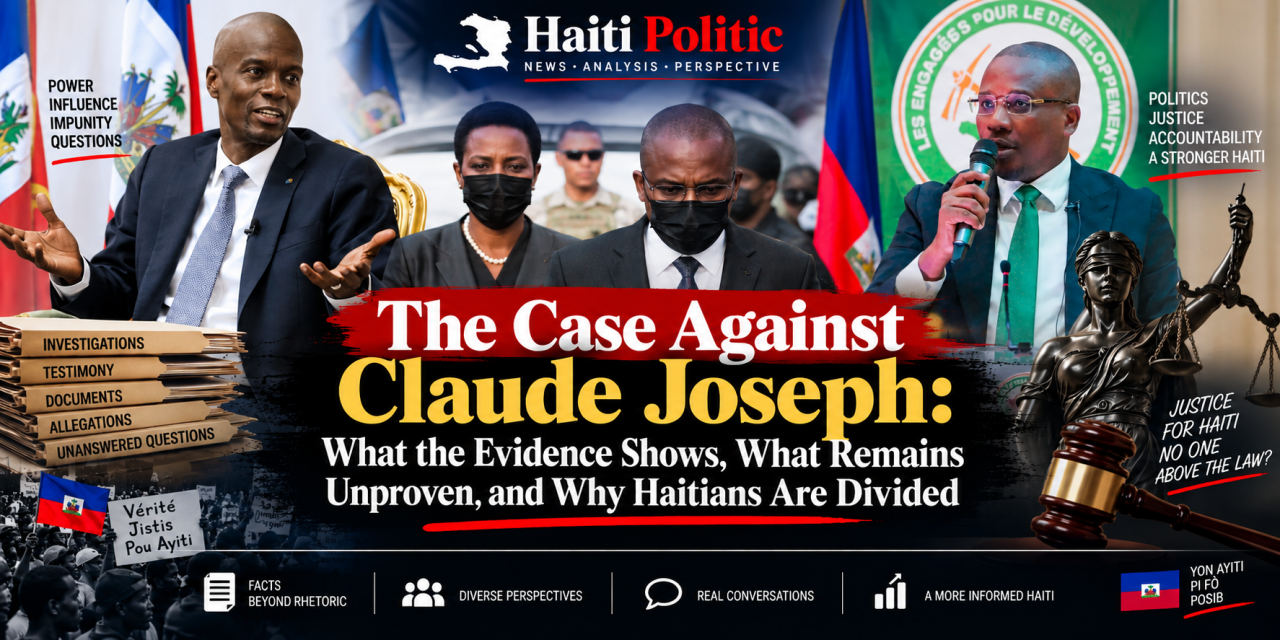
When gunmen stormed the private residence of Haitian President Jovenel Moïse in the early hours of July 7, 2021, and shot him to death, the man who stepped forward within hours to declare himself acting head of state was Claude Joseph — at the time, the outgoing foreign minister who had been serving as interim prime minister pending a transition already underway to his successor, Ariel Henry. More than five years later, Joseph is not just a former prime minister answering historians’ questions about that night. He is a criminally indicted defendant, and the question of what he knew, when he knew it, and what he did with the power he seized in the assassination’s chaotic aftermath remains one of the most consequential unresolved mysteries in modern Haitian politics.
The Indictment
In February 2024, Judge Walther Wesser Voltaire — the fifth investigating judge to take on the case after four predecessors recused themselves, citing threats and inadequate security — issued a 122-page final report indicting 51 people in connection with the assassination. Among them: Moïse’s widow, Martine Moïse; former national police chief Léon Charles; and Claude Joseph. Where the most serious defendants, including Charles, face murder and conspiracy charges, prosecutors accused Joseph and Martine Moïse of the somewhat narrower charges of complicity and criminal association — allegations that they did not pull triggers, but that they were connected to those who planned or enabled the killing.
Joseph rejected the indictment before Haiti’s Court of Appeal across three hearings in June 2025, testifying for hours and denying any involvement. His case, along with those of other appellants, was subsequently severed from the broader proceeding in March 2026, a procedural step that leaves the ultimate judicial resolution of his personal culpability still pending as of this writing.
The Case Against Him
Three threads make up the substance of the accusations against Joseph, separate from the formal charge sheet itself.
1. The question of foreknowledge and command failure. As acting prime minister, Joseph was nominally in the chain of command over the security forces responsible for protecting the president, including the presidential guard unit that mounted no effective resistance the night of the attack. Investigators and Haitian commentators have pressed a basic question that Joseph has never fully answered to critics’ satisfaction: how did an operation involving dozens of participants — reportedly including Colombian mercenaries and communications intercepted by Haitian intelligence in the weeks prior — proceed undetected by a government headed, in practice, by the man who would seize power hours after it succeeded? Joseph has maintained he had no advance knowledge, but the coincidence of timing — a plot succeeding just as he was about to be replaced, followed by his own consolidation of authority — has fueled suspicion that has never been fully dispelled by the public record.
2. The power-grab allegation. Before Moïse’s assassination, Joseph was already a lame duck; Moïse had named Ariel Henry as the incoming prime minister just two days before his death, and Henry had not yet been sworn in. In the hours after the killing, Joseph asserted that he — not Henry — remained the legitimate head of government, citing the constitutional provisions governing presidential succession, and he held onto executive authority for roughly three more weeks before ultimately ceding power to Henry under pressure from Haitian political actors and the diplomatic “Core Group” of foreign governments. Critics have characterized this as Joseph exploiting a security catastrophe to extend his own hold on power at a moment when Haiti’s constitutional order was already fragile enough that the country could ill afford a leadership contest.
3. Criminal-association allegations. Beyond the circumstantial questions, Judge Voltaire’s formal report ties Joseph to a broader web of alleged complicity that also implicated Martine Moïse — the specific evidentiary basis for the “criminal association” charge against Joseph has not been made fully public, and Joseph’s attorneys have challenged both the process (questioning conducted without full legal counsel present, and documents defendants say they signed without understanding, according to procedural appeals raised in the case) and the underlying evidence.
Joseph’s Defense
Joseph has been consistent and emphatic in denying wrongdoing since the indictment became public. His central arguments:
- Political persecution, not justice. Joseph has repeatedly described the case against him as a “classic coup d’état” carried out through the courts rather than the streets — a weaponization of Haiti’s judiciary by political rivals seeking to eliminate him as a future political contender. He has directly accused figures aligned with Ariel Henry, whom he pressured to resign amid the country’s later gang crisis, of orchestrating the charges in retaliation.
- He invited international scrutiny. Joseph points to the fact that in the assassination’s immediate aftermath, it was his government that formally requested FBI and Colombian assistance and wrote to the United Nations and the Organization of American States seeking international support for the investigation — a decision he argues is inconsistent with someone attempting to cover up his own involvement.
- The investigation’s chaotic history undercuts confidence in its conclusions. The fact that four judges before Voltaire abandoned the case, some citing personal safety fears, has been cited by Joseph and his supporters as evidence that the entire process has been compromised by political interference from multiple directions — making any single judge’s indictment, in their view, an unreliable final word.
Where This Leaves Haitians
The honest answer is: still waiting. Joseph has not been convicted of anything, and Haiti’s judiciary — beset by the same institutional weakness, personnel turnover, and physical insecurity that plague the rest of the state — has yet to produce a resolution either exonerating him or proving the criminal-association charge to a standard that would satisfy independent observers. The U.S. federal case running in parallel, which has already produced convictions of several of the alleged operational plotters, has not, at least publicly, extended culpability up to Joseph.
What can be said with confidence is narrower than either his critics’ harshest framing or his own claim of pure persecution suggests: Joseph occupied the most consequential seat of power in Haiti at the exact moment its head of state was murdered under his nominal security umbrella, he used the opening that created to hold executive authority for several weeks against a named successor, and a Haitian judge — operating within a deeply strained but not wholly captured judicial process — found enough to formally charge him. Whether that adds up to complicity in murder, opportunistic ambition falling short of a crime, or a genuinely unlucky official caught in a political vendetta is precisely the question Haiti’s courts have not yet finished answering. Haitians weighing whether to trust Claude Joseph’s account of that night are, in that sense, in the same position as everyone else watching from outside: forced to judge an unfinished case.
This article is based on Haitian judicial filings and reporting, U.S. federal case records. It reflects an ongoing, unresolved legal matter; Claude Joseph has not been convicted of any charge related to the assassination, and the allegations described above remain contested.