The Organization of American States says its fourth Group of Friends of Haiti meeting is advancing political, technical and financial support for the country. But the language deserves scrutiny. The OAS does not possess a large independent development treasury, its regular budget depends heavily on member-state contributions, and Washington alone is assessed nearly half of that fund. So when the OAS promises to “mobilize” money for Haiti, it is important to understand what that word actually means—and what it does not mean.
By Haiti Politic | Foreign Policy & Institutional Accountability
The Organization of American States posted an ambitious message on September 4, 2026:
“The OAS is advancing the mobilization of political, technical, and financial support for Haiti through the fourth meeting of the Group of Friends of the Caribbean country.”
At first glance, it sounds as though the OAS is assembling another major financial package for Haiti.
But read the language carefully.
The organization did not say:
“The OAS is providing Haiti with X million dollars.”
It said it is “advancing the mobilization” of support.
That distinction is fundamental.
And once we examine how the OAS is financed, what Secretary General Albert Ramdin has actually been saying, and what happened at the September 4 meeting, the statement becomes much easier to understand.
It is not accurate, based on the evidence currently available, to call the OAS post a lie.
But Haitians would be equally mistaken to interpret it as an OAS guarantee that large amounts of new money are already funded and ready for Haiti.
What the OAS appears to be offering is something different:
It wants to become the convener, coordinator and broker that persuades other governments, development banks, international organizations and private actors to provide the resources.
And Haiti has more than enough history with international promises to ask the obvious question:
Who has actually committed the money?
What Happened on September 4?
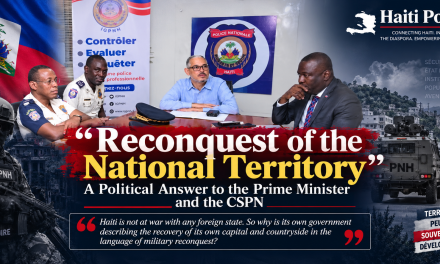
The meeting shown in the OAS post was real.
According to the organization’s official calendar, the fourth meeting of the Group of Friends of Haiti took place September 4 at OAS headquarters in Washington.
Its agenda included Haiti’s political situation, the OAS high-level mission to Haiti, the OAS Special Mission, implementation of its Haiti Roadmap and—most importantly for this discussion—an “overview of pledges.” Member states, permanent observers and international organizations were invited to participate.
That last word is revealing:
pledges.
The OAS itself is therefore signaling that much of this mechanism involves gathering commitments from others.
That is different from possessing the money itself.
First, Follow the OAS’s Own Money
The OAS’s approved 2026 budget provides an important reality check.
Its Regular Fund quota assessments totaled approximately $93.86 million before certain adjustments and tax reimbursements.
The United States’ assessed share was:
49.990%
That translated into a U.S. quota assessment of approximately $46.9 million, plus an estimated $6.1 million tax-reimbursement component reflected in the budget table.
Canada’s assessment was roughly $12.67 million, Brazil’s about $11.33 million and Mexico’s about $8.68 million.
So the user’s underlying concern is legitimate:
The OAS is heavily dependent upon its member governments, particularly the United States.
It is not sitting on an enormous independent pool of money comparable to the World Bank or Inter-American Development Bank.
And its finances have vulnerabilities.
The OAS’s proposed 2027 budget disclosed that, as of March 19, 2026, approximately $64.6 million in 2026 quotas remained unpaid, warning that delayed contributions create financial instability for the organization.
That makes the phrase “mobilizing financial support” worth examining closely.
So Where Is the Money for Haiti Supposed to Come From?
This is the key.
The evidence suggests that the OAS’s Haiti strategy is based on multiple financing channels, rather than the OAS Regular Fund paying for Haiti’s recovery itself.
Secretary General Ramdin essentially explained the model in his September 3 presentation to the Permanent Council.
The actors he identified include:
OAS member states and permanent observers; bilateral donors such as Japan and Canada; the World Bank; the Inter-American Development Bank; CAF—Development Bank of Latin America and the Caribbean; PAHO; international organizations; NGOs; private-sector organizations; and other implementing partners.
In other words:
The OAS isn’t necessarily saying, “We have the money.”
It is saying:
“We are trying to organize the people and institutions that have the money.”
That’s a completely different proposition.
We Already Have a Concrete Example: Japan’s $3 Million
The clearest example came only weeks before this meeting.
During the August OAS-led international mission to Haiti, a $3 million cooperation agreement with Japan was signed to strengthen civil identification.
The funding is intended to support approximately 350,000 biometric identification cards, mobile registration services and stronger coordination between Haiti’s National Identification Office, ONI, and the Provisional Electoral Council, CEP.
Notice the financing architecture.
It isn’t simply:
OAS → Haiti → $3 million.
Japan is providing the financial resources.
The OAS is helping structure, coordinate and implement the initiative.
That appears to be what mobilization means in practice.
And that distinction should have been clearer in the social-media post.
Then There Is CAF: $168 Million Is Not OAS Money Either
There is an even larger example.
Ramdin told the Permanent Council that Haiti’s accession to CAF—Development Bank of Latin America and the Caribbean could give Haiti access to approximately:
$168 million
in financing, technical cooperation and development tools.
He specifically said the OAS facilitated the operation.
Again:
The OAS isn’t writing a $168 million check.
CAF is the financial institution.
The OAS is the facilitator.
That’s an important accomplishment if the financing ultimately produces useful projects.
But Haiti Politic believes the distinction should be made explicit every time these numbers are presented publicly.
Facilitating access to $168 million is not the same as giving Haiti $168 million.
And “access to financing” isn’t necessarily the same as a grant.
Depending upon the instrument, financing can potentially involve loans, concessional terms, technical assistance or other mechanisms.
Those details matter enormously for a country already struggling with weak public finances.
The OAS Is Also Asking Other Countries to Pay for Its Election Observation
There is an extraordinary sentence in Ramdin’s September 3 address that helps explain the entire financing model.
After announcing that Haiti had invited the OAS to deploy an Electoral Observation Mission for the scheduled December elections, Ramdin told OAS governments:
“Your financial contributions to be able to deploy this EOM will be essential.”
That is unusually clear.
The OAS wants to deploy the mission.
But it still needs countries to finance it.
The Secretary General similarly invited member states to provide “in-kind and financial support” for proposed trauma centers for wounded Haitian police officers.
He also welcomed financial and in-kind contributions for social and economic programs.
Therefore the September 4 language isn’t mysterious once we read the longer speech.
Mobilization means fundraising, coordination, diplomacy and coalition-building.
That Doesn’t Make the Statement a Lie
This distinction is important.
There is a legitimate criticism to make here.
But calling the OAS statement a lie would require evidence that the organization knowingly made a materially false representation.
The available evidence doesn’t establish that.
In fact, the evidence shows actual mobilization taking place:
Japan committed $3 million.
CAF financing access is being developed.
The IDB and World Bank participated in the high-level mission.
PAHO is involved.
Canada has supported work implemented with Viva Rio.
The OAS is seeking additional contributions for electoral observation, police trauma centers and socioeconomic projects.
So “mobilizing” is defensible diplomatic terminology.
The stronger criticism is different:
Mobilization should not be confused with capitalization.
A meeting isn’t money.
A pledge isn’t disbursement.
An announcement isn’t implementation.
And access to financing isn’t necessarily money already available to the Haitian government.
Haiti Has Heard “The International Community Is Mobilizing” Before
This is where history becomes uncomfortable.
Haitians have spent decades hearing variations of the same vocabulary:
Support.
Coordination.
Technical assistance.
International partners.
Democratic consolidation.
Institutional strengthening.
Capacity building.
Mobilization.
Roadmap.
Transition.
The terminology changes.
The institutions remain.
And Haiti continues moving from transition to transition.
That doesn’t prove that every OAS initiative is worthless.
But it absolutely justifies skepticism.
The OAS’s Involvement in Haiti Is Not New
The OAS has been deeply involved in Haiti’s political and electoral affairs for decades.
After Haiti’s 1991 military coup, the OAS and United Nations established the International Civilian Mission in Haiti, MICIVIH, to monitor human rights and later assist with institution-building.
Following the political crisis surrounding the 2000 elections, the OAS established its Special Mission for Strengthening Democracy in Haiti, working in security, justice, human rights, governance and institutional development.
The OAS’s own report on Haiti’s May 2000 elections criticized the methodology used by the CEP to allocate certain Senate seats. When the dispute wasn’t resolved, the OAS observation mission declined to observe the second round, and an extended political crisis followed.
By 2004, Haiti had entered another catastrophic political rupture.
Interestingly, the OAS’s own Assistant Secretary General Luigi Einaudi later described what had happened as a “disaster” and acknowledged that despite extensive OAS efforts, the organization had failed to prevent the outcome.
That historical admission deserves to be remembered whenever the OAS returns promising another framework for Haitian political stability.
And Then Came the Controversial 2010 Election
Perhaps no episode better explains Haitian suspicion toward the OAS than the disputed 2010 presidential election.
Following the first round, President René Préval requested OAS technical assistance to verify disputed results.
The OAS assembled an expert mission to review vote tabulation.
The mission found serious irregularities and fraud in polling-station records and proposed possible remedies.
The broader OAS-CARICOM observation mission itself acknowledged something particularly important: because the OAS was already involved in election preparation—including technical assistance connected with national identification—it faced criticism that it was effectively both participant and evaluator.
Its own final report explicitly noted criticism that the organization was becoming “judge and party” in the electoral process.
That phrase should matter in 2026.
Because the OAS is once again providing electoral technical assistance.
The OAS Is Already Inside Haiti’s 2026 Electoral Machinery
Ramdin disclosed this week that an OAS Electoral Task Force has been operating for months.
According to him, it has provided technical cooperation to the CEP for systems involving party representatives and polling-station workers.
More significantly:
The OAS helped develop the software for Haiti’s candidate-registration system.
That software is now live and being used by the CEP.
At the same time, Haiti has invited the OAS to deploy an Electoral Observation Mission for the December election.
Ramdin appears aware of the potential conflict.
He explicitly promised that the OAS would carefully distinguish where its electoral cooperation responsibilities end and its electoral observation responsibilities begin.
That is welcome.
But Haitians have every right to scrutinize that firewall.
Because the historical concern isn’t theoretical.
The OAS’s own 2010–2011 reporting recorded essentially the same criticism.
Is This Assistance—or Political Interference?
The answer cannot responsibly be reduced to either extreme.
Saying:
“The OAS has no business in Haiti whatsoever”
ignores several realities.
Haiti is an OAS member.
Haitian governments have repeatedly requested OAS assistance.
The organization has treaty-based mandates involving democracy, human rights, electoral observation and regional cooperation.
In 2010, for example, the controversial verification mission didn’t simply invade the electoral process uninvited; President Préval requested technical assistance.
But the opposite argument is equally unsatisfactory:
“The OAS is merely providing neutral technical assistance.”
Once an international organization helps design electoral systems, advises electoral institutions, mobilizes financing, assesses candidate rules, provides political “good offices,” coordinates foreign governments and later observes the election, its influence is clearly political in consequence—even when exercised under a legal mandate or Haitian invitation.
That does not automatically make it illegitimate.
But it makes accountability essential.
And There Is Another Problem: The United States
This is where Haiti’s sovereignty debate becomes unavoidable.
The United States pays nearly half of the OAS Regular Fund assessment.
That does not prove that Washington dictates every OAS decision.
The OAS consists of member states, and its political organs have their own voting and institutional procedures.
But financial dependence creates a legitimate structural question:
Can an organization whose largest member finances roughly half of its Regular Fund ever be perceived as completely independent when dealing with a country where that same member has enormous strategic influence?
That isn’t conspiracy.
It is institutional analysis.
The appropriate response isn’t to claim automatically that every OAS decision is secretly a U.S. order.
The appropriate response is transparency.
Who proposed the initiative?
Who pays?
Who administers the money?
Who chooses contractors?
Who establishes performance indicators?
Who audits expenditures?
Who determines whether objectives have been met?
Those answers tell us far more than slogans about imperialism or international solidarity.
Haiti Politic Proposes a Simple Rule: Show Us the Money
If the OAS wants Haitians to believe that the fourth Group of Friends meeting represents something different, publish a financing dashboard.
For every Haiti initiative, disclose:
| Initiative | Amount | Funding Source | Grant/Loan | Implementer | Recipient | Disbursed | Results |
|---|---|---|---|---|---|---|---|
| Civil identification | $3M | Japan | Clarify terms | OAS/partners | ONI/CEP | Publish status | 350,000 cards target |
| CAF access | Up to ~$168M | CAF | Specify instruments | CAF/Haiti | Haiti/projects | Publish status | Publish projects |
| OAS Electoral Observation Mission | TBD | Donor contributions | Contributions | OAS | EOM | TBD | Election observation |
| HNP trauma centers | TBD | Member states/partners | Cash/in-kind | OAS/PAHO/partners | HNP | TBD | Publish targets |
| Electoral technical assistance | Publish | Publish | Publish | OAS/CEP | CEP | Publish | Systems delivered |
| Youth/social-cohesion programs | Publish | Canada/others | Publish | Viva Rio/partners | Haitian communities | Publish | Publish indicators |
The first two figures are supported by current OAS statements; several other financial details remain unspecified publicly in the sources reviewed.
This is what accountability looks like.
Not another communiqué.
A ledger.
The Group of Friends Should Answer Five Questions
The next time the OAS says it is “mobilizing financial support,” Haitians should ask:
How much? From whom? Under what conditions? Who controls it? When will Haitians see the result?
Those five questions could eliminate half the confusion surrounding international assistance.
Because Haiti’s problem has never simply been the number of international meetings held on its behalf.
Haiti may be one of the most internationally discussed countries in the hemisphere.
The problem is converting discussion into institutions that actually function.
The OAS Roadmap Itself Reveals the Strategy
The OAS describes its Haiti Roadmap not primarily as a giant financing mechanism but as a political and operational framework designed to coordinate solutions, align multilateral and regional partners, bring donors together and create greater coherence among existing initiatives.
That’s important.
The OAS is essentially trying to position itself as a catalyst.
And perhaps Haiti does need better international coordination.
There are too many actors.
United Nations.
OAS.
CARICOM.
World Bank.
IDB.
CAF.
PAHO.
Bilateral governments.
NGOs.
Security missions.
Humanitarian agencies.
Development organizations.
Donors.
Private contractors.
Coordination failure is itself a serious problem.
But coordination becomes dangerous when it evolves into substitution.
International institutions should coordinate assistance to Haitian institutions.
They should not gradually become substitutes for Haitian institutions.
Twenty-Five Years Later, the Question Is No Longer Whether the OAS Means Well
This is where the historical record matters.
The OAS was deeply involved after the disputed 2000 elections.
It was deeply involved during the 2001–2004 crisis.
It supported democratic institutions after Aristide’s departure.
It helped with voter registration.
It participated in the 2006 electoral process.
It played an extraordinarily consequential role in the disputed 2010–2011 election.
It has repeatedly provided electoral assistance.
And now, in 2026, it is again helping Haiti prepare for elections, developing electoral technology, supporting identification, discussing candidate standards, preparing an observation mission, mobilizing donors and coordinating political support.
After that much involvement, Haitians are entitled to ask:
Where are the durable institutions?
That isn’t an argument that the OAS caused Haiti’s collapse.
Haiti’s political class, economic actors, armed networks, institutional failures and domestic conflicts carry enormous responsibility.
Nor should foreign intervention become an excuse absolving Haitian leaders of their own decisions.
But after decades of international institution-building programs, the international organizations involved must also accept evaluation.
So: Is the OAS Lying?
Based on the evidence available today:
No evidence establishes that this September 4 statement is a lie.
There are identifiable mechanisms through which the OAS is mobilizing resources.
Japan’s $3 million is real.
CAF’s financing opportunity is real.
Development banks are participating.
Member states are being asked for contributions.
International organizations are involved.
Private-sector participation is being sought.
But there is an equally important conclusion:
The OAS has not demonstrated that it possesses all the financial resources necessary to fulfill the ambitions it is presenting for Haiti.
Much of the strategy depends upon other actors actually providing money, personnel, equipment and technical resources.
And Ramdin himself effectively acknowledged that problem when he urged countries and partners to fulfill commitments already made and accelerate delivery.
So the more accurate verdict is:
Not necessarily a lie. Definitely a promise that remains partly dependent on other people’s money.
That difference matters.
Haiti Should Stop Measuring International Support by Announcements
The September 4 meeting should not be judged by photographs.
Not by tweets.
Not by diplomatic statements.
Not by how many ambassadors attended.
Not even by how much money is pledged.
Judge it one year from now.
How much money was actually transferred?
How many national ID cards were delivered?
How many voters were registered?
Did the electoral systems work?
Was the election credible?
Were Haitian institutions strengthened?
Did police officers receive better medical support?
Were promised security resources delivered?
Did CAF financing produce functioning projects?
Were jobs created?
Was the money audited?
And perhaps the most important question:
Could Haiti continue these programs if the international organizations left?
If the answer is no, then Haiti hasn’t built institutional capacity.
It has built another dependency.
Haiti Doesn’t Need Another International Guardian
It needs partners.
There is a difference.
A partner helps Haiti develop capacity.
A guardian makes decisions Haiti eventually becomes incapable of making without it.
A partner transfers knowledge.
A guardian creates permanent dependence.
A partner respects Haitian law and institutions.
A guardian gradually replaces them.
The OAS says its current Roadmap is Haitian-led, and that principle should be taken seriously and tested against implementation.
Because after decades of foreign assistance, Haiti cannot afford another political architecture in which international organizations become stronger while Haitian institutions remain weak.
The Question the OAS Should Answer
Secretary General Albert Ramdin says the international community must move from commitments to implementation and results.
Haiti Politic agrees.
So let’s apply that standard to the OAS itself.
When the organization says:
“We are mobilizing political, technical and financial support for Haiti”
Haitians should respond:
Excellent. Publish the commitments.
Tell us which country pledged what.
Tell us whether it is a grant or loan.
Tell us when it becomes available.
Tell us who manages it.
Tell us what conditions accompany it.
Tell us what percentage reaches Haitian institutions.
Tell us how success will be measured.
Tell us what happens if donors don’t pay.
And twelve months from now:
Tell us what was actually delivered.
Because after more than two decades of international roadmaps, special missions, electoral missions, transition frameworks, donor conferences and political mediation, Haiti doesn’t need another promise that photographs well in Washington.
It needs receipts.
HAITI POLITIC — Analyze. Inform. Empower.
Editor’s note: This is an analysis and opinion article. “Interference” is a contested characterization. The historical record includes both Haitian requests for OAS assistance and serious controversies over the organization’s influence in electoral and political processes. The article distinguishes OAS Regular Fund resources from financing mobilized from bilateral donors, development banks and other partners.